


BLOG
Snapchat for Business: The Complete Guide to Marketing on Snap
Let us be direct about something. If your business is still treating Snapchat as a platform for teenagers and ignoring it completely, you are making a strategic mistake — and the window to get in early is closing faster than most brand managers realise. Snapchat is not the future of social media. In many respects, for the audiences that matter most to B2C brands right now, it is the present.
This is not a platform overview. This is a practical guide for businesses that are ready to stop dismissing Snapchat and start using it properly — covering why it works, what to post, how to build a following, how to advertise, and how to fit it into a social media strategy that already includes Instagram, Facebook, and everything else competing for your attention and budget.
We have written before about the battle between Snapchat and Instagram and the distinct roles each platform plays for brands. This article goes deeper on Snapchat specifically — and makes the case that it deserves a dedicated strategy of its own.
Why Snapchat Is Different From Every Other Platform
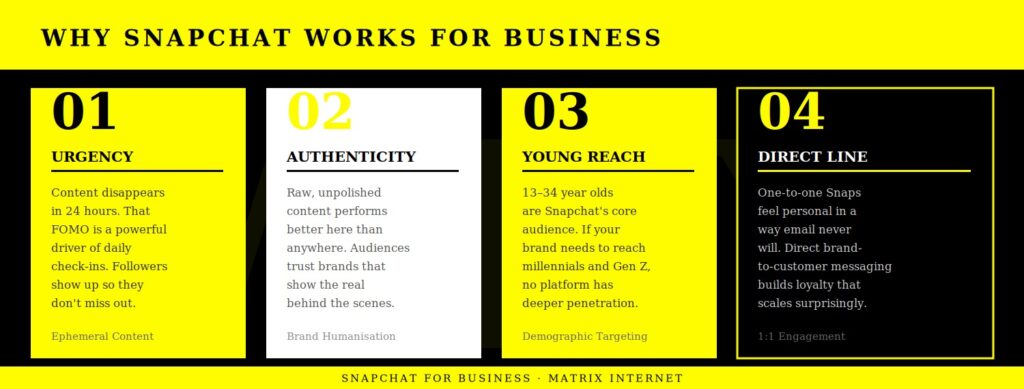
Snapchat was built around a single, radical idea: what if content disappeared? In a social media landscape where everything is archived, searchable, and permanent, Snapchat introduced impermanence — and it changed the psychology of how people share. When your content vanishes after 24 hours, you stop performing for posterity and start communicating in the moment.
That is the foundation of why Snapchat works differently for businesses. Every other major platform rewards curation — the carefully edited photo, the perfectly worded post, the thumbnail-optimised video. Snapchat rewards authenticity. Content that looks polished and produced feels out of place here. Raw, real, and in-the-moment content performs. For brands willing to drop the corporate mask and communicate like human beings, this is an extraordinary opportunity.
“On Snapchat, B2C communication starts to feel like C2C — a warm, personal interaction between two human beings rather than a brand broadcasting at a customer.”
There is also the question of attention. Snapchat users who follow a business account are actively choosing to engage — they are opening the app, navigating to that account, and watching its content by intention. There is no passive scroll. The engagement rate among genuine Snapchat followers is, as a result, significantly higher than equivalent audiences on platforms where content is served algorithmically, whether the user sought it out or not.
Who Is Actually on Snapchat?
The demographic picture of Snapchat matters enormously for understanding whether it belongs in your strategy. According to Snap Inc.’s own figures, the platform reaches over 300 million daily active users globally, with particularly strong penetration in the 13–34 age bracket. In many markets, Snapchat reaches more people under 25 than television.
If your business sells to a younger consumer demographic — fashion, food and drink, entertainment, gaming, beauty, sports, lifestyle, travel — Snapchat is not a fringe channel. It is one of the primary ways your target audience communicates, shares experiences, and discovers brands. The question is not whether they are on Snapchat. It is whether your brand is present when they are.
For B2B businesses or brands targeting older demographics, the calculus is different. Snapchat’s value diminishes considerably if your audience skews over 40 or operates primarily in professional contexts. But for any business with a meaningful stake in the 16–34 consumer market, the platform demands serious consideration.
Setting Up a Snapchat Business Account
Snapchat offers two distinct paths for businesses: a standard public profile accessible through the regular app, and a dedicated Snapchat Business Account created through the Ads Manager platform, which unlocks advertising tools, analytics, and a more structured brand presence.
For most businesses, starting with a public profile and building a following organically before investing in paid advertising is the right approach. Here is how to set up properly:
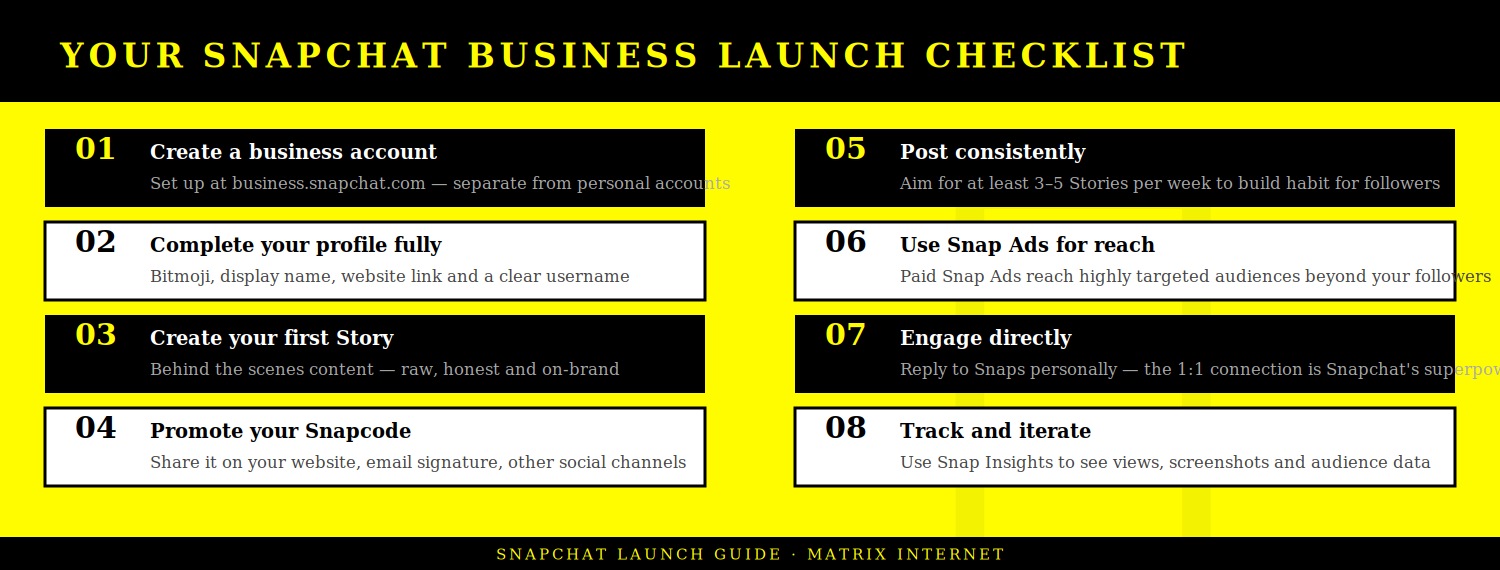
Choose your username carefully. Your Snapchat username cannot be changed once set. Make it your brand name, as clean and short as possible. Avoid numbers or underscores unless they are genuinely part of your brand identity. Your username is what people will search for and what you will print on marketing materials, so it needs to be memorable and accurate.
Complete your profile fully. Set a recognisable profile image — your logo for most businesses — add your website URL, and write a clear display name. Snapchat’s Bitmoji integration allows for a custom brand avatar which, used thoughtfully, can add personality to your presence.
Generate your Snapcode. Your Snapcode is the unique QR code that allows anyone to add your account instantly by pointing their camera at it. Print it. Put it on packaging, in your email signature, on event materials, on your website. This is Snapchat’s most frictionless onboarding mechanism and should be promoted actively across every channel where your audience already finds you.
What to Actually Post: Content That Works on Snapchat
The cardinal rule of Snapchat content is this: do not repurpose content from other platforms. What works on Instagram will not work here. What works here will rarely work on Instagram. Snapchat has its own content language, and brands that ignore this and post the same polished creative they use everywhere else will find it lands flat.
Behind-the-scenes content
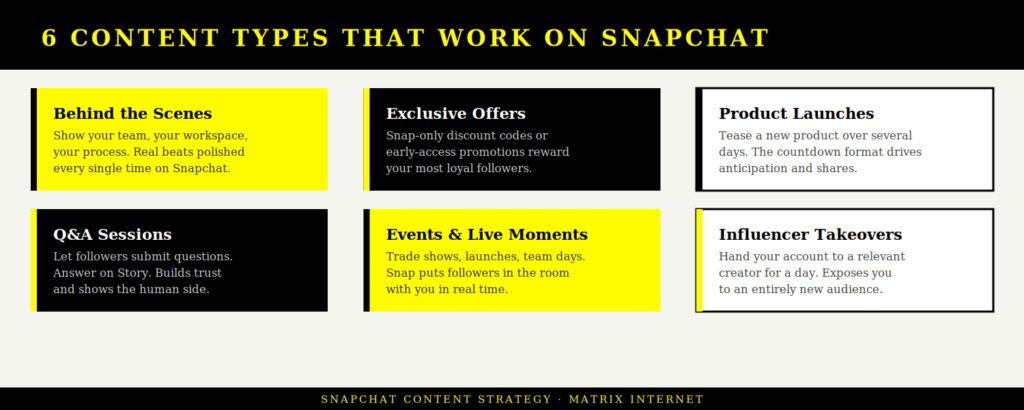
This is Snapchat’s native format and it performs consistently better than anything else for business accounts. Show your team at work. Show how a product is made. Show the unglamorous reality of running a business — the messy studio, the midnight deadline, the team lunch. This content would be inappropriate or off-brand on Instagram. On Snapchat, it is exactly what the audience wants, and it builds the kind of genuine brand affection that no amount of polished advertising can buy.
Exclusive, time-limited offers
The ephemeral nature of Snapchat content makes it the perfect vehicle for genuinely exclusive promotions. A discount code that appears in your Story and disappears after 24 hours creates real urgency — because it genuinely is limited. Followers who know your account posts exclusive Snap-only offers will check your Story regularly, building a habit of engagement that compounds over time. This is one of the most direct ways to drive measurable ROI from a Snapchat presence.
Product teasers and launch countdowns
Spreading a product launch across several days of Story content — a glimpse here, a hint there, a reveal on the final day — is a format that plays beautifully to Snapchat’s daily check-in dynamic. Each piece of content creates anticipation for the next. Your most engaged followers will be watching every day, and the FOMO of potentially missing a reveal is a powerful driver of consistent Story views.
Real-time event coverage
Snapchat is the best platform for live event coverage, precisely because it is not live in the broadcast sense — it is a running Story that accumulates through the day, giving followers a curated but authentic sense of being present at something they are not. Trade shows, product launches, team events, industry conferences — all of these translate well into Snapchat Stories that make your followers feel like insiders.
Q&A and direct engagement
Invite followers to send you Snaps with questions — about your products, your business, your team, your industry — and answer them on your Story. This format does something few other content types achieve: it makes individual followers feel directly seen and acknowledged. The brand that replies to its audience on Snapchat creates a relationship dynamic that is qualitatively different from any other platform. This is the C2C feeling that makes Snapchat uniquely powerful for loyalty building.
Influencer takeovers
Handing your Snapchat account to a relevant influencer for a day — someone whose audience overlaps with your target customer but has not yet discovered your brand — is one of the most effective growth tactics available on the platform. The influencer brings their audience with them; your brand is introduced in a trusted, authentic context. Unlike Instagram takeovers, which can feel staged, Snapchat takeovers work precisely because the format demands they be raw and real. For more on influencer strategy across platforms, our social media marketing team at Matrix Internet can help you identify the right partnerships.
Snapchat Advertising: Paid Reach Beyond Your Followers
Organic Snapchat growth is real but slow. For businesses that need to reach new audiences at scale, Snap Ads provide a paid advertising platform with targeting capabilities that are more sophisticated than many brands realise.
Snap Ads are full-screen vertical video ads that appear between Stories. They can run up to three minutes, though shorter formats (6–10 seconds) typically perform better. Snap’s targeting allows you to reach users by age, location, interests, device type, and — crucially — by lookalike audiences based on your existing customer data. The swipe-up functionality links directly to a website, app download, or long-form video, making conversion tracking straightforward.
Story Ads appear in the Discover section and allow brands to package multiple Snaps into a single sponsored unit. These work well for more complex brand narratives — product demonstrations, multi-part stories, or content that benefits from sequential viewing.
Filters and Lenses are Snapchat’s most distinctive and memorable ad format. A branded filter overlays your logo or creative on user-generated Snaps; a branded Lens uses augmented reality to place your brand’s creative — a hat, a product overlay, an animated effect — onto the user’s face or environment. When users apply your Lens and send it to friends, those friends see your brand. The organic sharing mechanic is built in. For event marketing, product launches, and campaigns targeting younger audiences, Lenses in particular can generate significant earned impressions at a cost that compares favourably with traditional digital advertising.
Measuring Success on Snapchat
Snapchat’s analytics, accessed through Snapchat Ads Manager for business accounts, provide metrics that align closely with the platform’s unique engagement dynamic. The key figures to track are:
Story Views — how many unique users watched each Story. This is your reach metric and the primary indicator of how your content is resonating with existing followers.
Completion Rate — the percentage of users who watched your Story all the way through. A high completion rate indicates compelling content; a low rate suggests you are losing people early, which usually means your opening frame needs to work harder.
Screenshots — when a user screenshots your content, it typically signals high interest — they want to save or share something specific. Track which content generates screenshots and make more of it.
Swipe-Ups — for content with a call to action linking to your website, swipe-up rate is your conversion metric. This is where Snapchat activity connects to measurable business outcomes.
For paid campaigns, Snap Ads Manager provides standard digital advertising metrics — impressions, CPM, CPC, conversion events — alongside Snap-specific data on Lens interactions and filter uses. Connecting Snap campaign data to your broader digital marketing analytics framework gives you a complete picture of how the platform contributes to your overall customer acquisition and retention metrics.
Getting Started: Your Snapchat Launch Plan
The most common reason businesses fail on Snapchat is not the platform — it is the approach. They treat it like a broadcast channel, post content designed for other platforms, do not engage with followers directly, and give up after a few weeks when follower numbers do not immediately skyrocket. Snapchat rewards consistency and authenticity over time, not overnight vanity metrics.
A realistic first 90 days looks like this: spend the first month finding your content voice — experiment with behind-the-scenes formats, try a Q&A, test an exclusive offer. Spend the second month promoting your Snapcode actively across every channel you own and building the habit of posting at least three to five times per week. By month three, you should have enough data from Snap Insights to know which content types resonate most with your specific audience — and you can begin building a content strategy around what actually works rather than what you assumed would.
If you want to accelerate this process with paid advertising, starting with Snap Ads targeted at lookalike audiences based on your existing customers is the most efficient path to reach. A small test budget — even a few hundred euros or pounds — will tell you quickly whether your target audience responds to your messaging on Snapchat, before you commit to a larger campaign spend.
Is Snapchat Right for Your Business?
There is an honest answer to this question, and it is not “yes for everyone.” Snapchat rewards investment from brands whose audience is present on the platform, whose content can genuinely embrace the raw and authentic format, and whose team has the capacity to post consistently and engage with followers directly. If any of those three conditions are not met, the return on effort will be limited.
But for businesses selling to younger consumers, for brands with genuine personality and a willingness to communicate like human beings rather than marketing departments, and for marketers who understand that loyalty is built through connection rather than broadcasting — Snapchat offers something no other platform currently replicates at scale.
The brands that understood this in 2013 and 2014 built audiences that their competitors spent years trying to catch up with. The brands that understand it now, before Snapchat’s business tools become as crowded and competitive as Facebook and Instagram, have the same opportunity. The window is still open. The question is whether you are ready to step through it.
If you would like to discuss whether Snapchat belongs in your social media strategy — and how to build a plan that actually delivers results — the social media marketing team at Matrix Internet would be glad to help. You can also explore our broader thinking on digital marketing for Irish businesses and how social platforms fit into a joined-up strategy.
By Matrix Internet


