


BLOG
AI Integrations for Ecommerce: Personalisation, Search and Support
4 min read
Artificial intelligence is transforming e-commerce by delivering measurable improvements in conversion rates, customer experience, and operational efficiency.
E-commerce is one of the areas where artificial intelligence delivers the most immediate and measurable return on investment. Unlike many technology implementations where benefits are diffuse and hard to attribute, AI integrations in e-commerce connect directly to metrics that matter: conversion rate, average order value, cart abandonment rate, and support cost per ticket. The improvements are visible in the data within weeks of deployment.
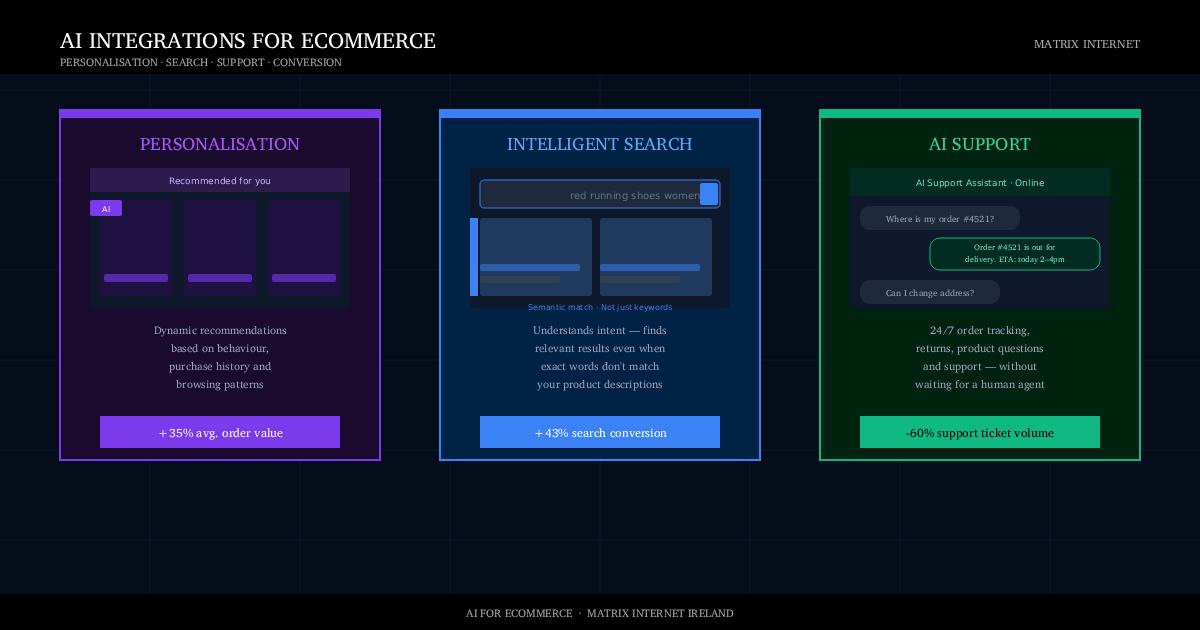
The three areas where AI has the most significant impact on e-commerce performance are personalisation, intelligent search, and customer support. Each addresses a different stage of the customer journey. Together, they create a shopping experience that feels relevant, frictionless, and responsive — which is precisely what converts browsers into buyers and buyers into repeat customers.
This guide covers how each of the three works, what the implementation looks like in practice, what results businesses are achieving, and how to decide where to start.
Why E-commerce Specifically Benefits From AI
E-commerce generates exactly the kind of data that AI learns from most effectively: large volumes of structured behavioural information — what products visitors view, what they search for, what they add to their cart, what they buy, what they return. This data, collected at scale over time, is the raw material from which AI systems build the models that power personalisation, search relevance, and support quality.
According to McKinsey research on personalisation, companies that excel at personalisation generate 40% more revenue from those activities than average players. Forrester’s ecommerce AI research consistently identifies search and recommendation as among the highest-return technology investments available to online retailers. The evidence base for AI in e-commerce is not theoretical — it is drawn from thousands of deployments across every category and scale of online retail.
The practical opportunity is particularly strong for mid-market and growing e-commerce businesses. Enterprise retailers have been using AI at scale for years. The cost and accessibility of AI through APIs have now brought the same capabilities within reach of businesses with smaller catalogues and teams, and the competitive pressure to implement is increasing as customer expectations — shaped by Amazon, Zalando, and other AI-native retailers — rise across the board.
AI Personalisation: Making Every Visitor Feel Like Your Only Customer
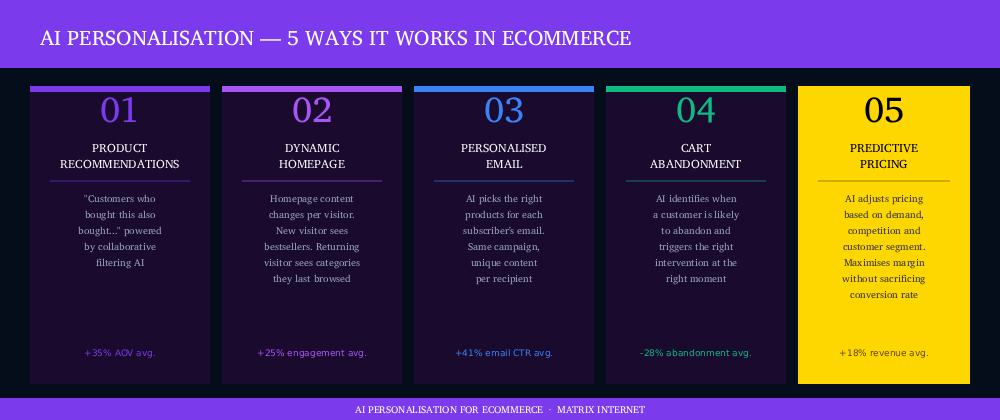
Personalisation in ecommerce means showing each visitor the products, content, and offers most relevant to them as an individual — based on what they have browsed, what they have bought, what similar customers have engaged with, and what the AI predicts they are most likely to want next.
Product recommendations
The most widely implemented form of ecommerce AI personalisation is product recommendations — the “customers who bought this also bought” and “you might also like” sections that appear across product pages, cart pages, and homepages. These are powered by collaborative filtering algorithms that identify patterns across thousands of customer journeys and apply those patterns to predict what any individual customer is most likely to want next.
Modern recommendation engines go significantly beyond simple co-purchase patterns. They incorporate real-time session behaviour — showing recommendations based on what a visitor has browsed in the last ten minutes, not just their historical purchase data — and can weight recommendations based on inventory availability, margin, and promotional priorities as well as relevance.
The revenue impact is well-documented. Barilliance’s ecommerce personalisation benchmarks consistently show recommendation-driven purchases accounting for a disproportionate share of revenue relative to the surface area they occupy — visitors who engage with a recommendation convert at significantly higher rates than those who do not.
Dynamic homepage and category pages
A static homepage shows every visitor the same featured products and promotions. An AI-personalised homepage shows each visitor the categories they are most likely to be interested in, the products most relevant to their browsing history, and the promotional messaging most likely to resonate with their segment.
For a returning customer who primarily buys running gear, the homepage surfaces running products. For a new visitor arriving from a campaign for cycling equipment, it surfaces cycling. This is not complex to implement — it requires connecting your CMS or ecommerce platform to a personalisation layer via API and defining the rules for how customer segments and behavioural signals map to content decisions.
Personalised email content
AI takes email personalisation beyond “Dear [First Name].” By analysing each subscriber’s purchase history, browsing behaviour, and engagement patterns, AI systems select the specific products, categories, and offers most likely to drive a click from each individual recipient — even when every subscriber receives the same campaign. The email template is shared; the product selection within it is unique to each recipient.
This approach consistently outperforms generic batch-and-blast email. Click-through rates from AI-personalised product selections are substantially higher than from manually curated product grids, because the AI is making selections based on individual relevance rather than editorial judgment about what is broadly appealing.
Cart abandonment prediction and recovery
AI can identify the behavioural signals that indicate a customer is likely to abandon their cart — hesitation on the checkout page, repeatedly revisiting the same product, extended inactivity mid-journey — and trigger a targeted intervention before the abandonment happens rather than after. This might be a well-timed chat message offering assistance, a subtle discount notification for a first-time customer, or a trust signal surfaced at the moment of hesitation.
Post-abandonment AI sequences — automated follow-up emails and ads targeted at customers who left without purchasing — can also be personalised to the specific products abandoned and the customer’s profile, making them significantly more effective than generic “you left something behind” messages.
AI Intelligent Search: Finding What Customers Mean, Not Just What They Type
Search is one of the most important and most underinvested functions on most e-commerce sites. Customers who use search are demonstrating active purchase intent — they are looking for something specific, and they want to find it now. When the search fails them, they leave. When search succeeds, they convert at rates two to three times higher than customers who browse.
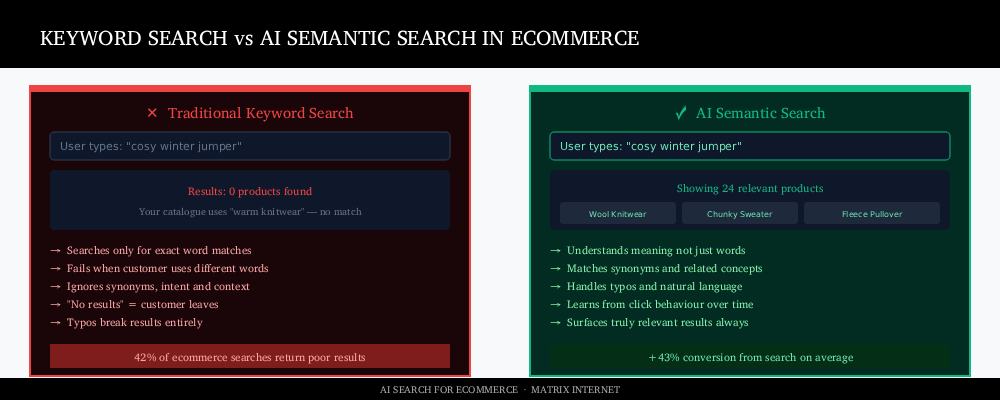
Traditional keyword search fails customers in predictable ways: it cannot handle synonyms (your catalogue says “knitwear,” the customer searches “jumper”), it breaks on typos, it ignores context (a search for “light jacket” might mean lightweight or light-coloured depending on the season), and it returns zero results pages that have no recovery mechanism. According to SearchNode’s ecommerce search research, a significant proportion of ecommerce site searches return poor or zero results — and the majority of those customers leave without purchasing.
How AI semantic search works
AI semantic search replaces word-matching with meaning-matching. Using a technique called vector embeddings, both your product catalogue and each customer query are converted into mathematical representations of their semantic meaning — capturing not just the words used, but the concepts, categories, and intent they represent. When a customer searches “cosy winter jumper,” the AI finds products whose semantic meaning is closest to the query, regardless of whether those exact words appear in the product descriptions.
This means your catalogue can be written in your brand voice, using whatever language best describes your products, without needing to anticipate every possible way a customer might search for them. The AI bridges the language gap automatically.
Additional AI search capabilities
Typo tolerance and natural language queries. AI search handles misspellings, grammatical variations, and fully natural language queries — “something to wear to a beach wedding” returns relevant results in a way that keyword search cannot.
Search-time personalisation. AI search systems can incorporate the searching customer’s history to influence result ranking — a customer who consistently buys premium products sees premium options ranked higher. A customer who primarily buys in size M sees in-stock size-M options surfaced more prominently.
Learning from click behaviour. AI search systems improve over time by learning from what customers click on and purchase after a search — gradually tuning result rankings to reflect what actually converts, not just what is semantically relevant.
Faceted search and filters. AI can suggest relevant filters automatically based on a search query — showing size and colour filters for a clothing search, compatibility filters for a technology search — reducing the friction between a search query and a refined, manageable results set.
Implementations like Algolia, Constructor.io, and vector search built on Pinecone or Weaviate all provide AI semantic search capabilities that can be integrated with most ecommerce platforms — including WooCommerce, Shopify, Magento, and custom-built stores — through well-documented APIs.
AI Customer Support: Resolving Queries Without the Wait
Customer support is one of the highest operational costs in e-commerce, and one of the clearest opportunities for AI to reduce cost while simultaneously improving the customer experience. The majority of e-commerce support queries are repetitive and structured — order status, returns, delivery questions, product specifications — which makes them ideal candidates for AI resolution.
What an e-commerce AI support assistant handles
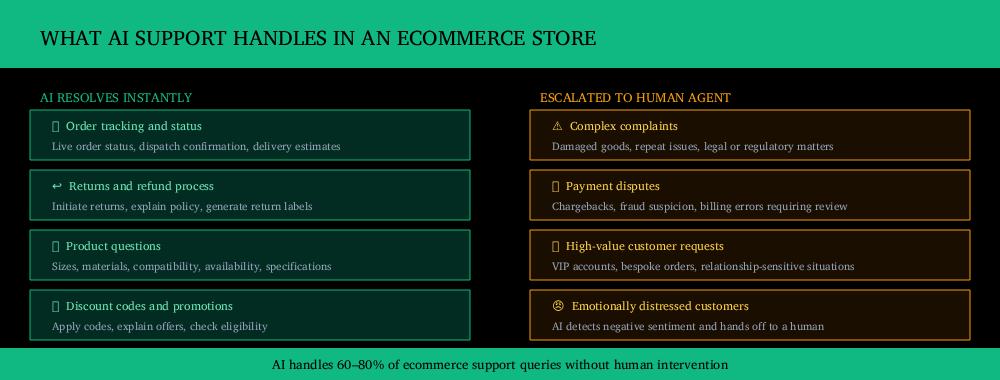
Order tracking and status. A customer asking “where is my order?” expects an immediate, accurate answer — not a reply in twenty-four hours. An AI assistant connected to your order management system can retrieve real-time order status, provide dispatch confirmation, share tracking links, and give delivery estimates instantly, at any hour, without a human agent involved. This is the highest-volume query category for most ecommerce businesses and the most straightforward to automate.
Returns and refund initiation. AI can walk customers through the returns process, confirm eligibility based on your policy and the order details, generate return labels, and initiate the refund process — all without human intervention. The customer gets the resolution they need immediately; your support team handles only the exceptions that require judgment.
Product questions. Size guides, material information, compatibility questions, availability by colour or variant — these are queries your AI assistant can answer based on your product catalogue data. A customer asking “does this come in a size 12?” or “is this compatible with iPhone 15?” gets an instant, accurate answer drawn from your product database.
Discount code and promotion queries. Applying promo codes, checking offer eligibility, explaining terms and conditions — AI handles these efficiently and consistently, without the variation in answer quality that comes from different agents interpreting the same policy differently.
Smart escalation
Effective AI support is not about replacing every human interaction — it is about AI handling the high-volume, structured queries so that human agents can focus on the complex, sensitive, or high-value situations that genuinely require human judgment. A well-designed ecommerce AI support integration includes intelligent escalation: the AI detects when a query is outside its competence, when sentiment analysis indicates a distressed customer, or when the situation involves a payment dispute or complaint that needs a human, and hands off to an agent with full context of the conversation so far.
According to Gartner’s customer service AI research, AI handles 60–80% of ecommerce support queries without human intervention in mature deployments. The human agents who remain handle genuinely complex cases — and because they are not spending time on order tracking queries all day, they are available faster and less burned out when complex situations arise.
Integration with your e-commerce platform
An AI support assistant for e-commerce needs to connect to more than just a language model. It needs access to your order management system to retrieve real-time order status, your product catalogue to answer product questions accurately, your returns management system to initiate returns, and your customer account database to personalise responses to the specific customer it is talking to. This is the integration work — connecting the AI’s reasoning capability to the live data it needs to be useful.
Platforms like Intercom’s Fin AI, Zendesk AI, and custom implementations built on OpenAI or Anthropic’s APIs all provide viable foundations for e-commerce AI support, with different trade-offs between out-of-the-box functionality and customisation flexibility.
Where to Start: Prioritising Your Ecommerce AI Investment
If you are evaluating AI integration for an e-commerce business, the question of where to start is important — not because any of the three areas is significantly harder or easier than the others, but because the right starting point depends on where your specific performance gaps are largest.
Start with AI search if your site analytics show a high rate of zero-results searches, your search-to-purchase conversion is significantly below your browse-to-purchase conversion, or you have a large catalogue where customers frequently cannot find what they are looking for. Improved search delivers measurable conversion lift quickly and is often the fastest return on ecommerce AI investment.
Start with personalisation if your average order value is below industry benchmarks for your category, your email click-through rates are low despite strong list sizes, or you have a returning customer base whose repeat purchase rate you want to improve. Personalisation typically shows its impact most clearly in AOV and email performance metrics.
Start with AI support if your support ticket volume is high, your team is spending significant time on repetitive queries, your average response time is more than a few hours, or customer satisfaction scores are being dragged down by support wait times. AI support delivers cost reduction and CSAT improvement simultaneously, with measurable impact within weeks of deployment.
Regardless of where you start, the data infrastructure is shared — your customer data, product catalogue, and order history underpin all three AI capabilities. Getting this data clean, accessible, and well-structured is an investment that pays dividends across every AI integration you subsequently build.
GDPR Considerations for E-commerce AI
Personalisation and support AI both involve processing personal data about your customers, which means GDPR compliance is a non-negotiable design requirement rather than an optional consideration. The key obligations are:
Lawful basis for processing. Personalisation that uses browsing and purchase behaviour to tailor the experience typically falls under legitimate interests — but this must be documented and balanced against customer rights. Where you use personalisation in email marketing, consent is the appropriate basis and must be properly obtained and recorded.
Data minimisation. Your AI systems should only process the customer data they actually need for their purpose. A product recommendation engine does not need to know a customer’s home address; an order tracking chatbot does not need their full purchase history going back five years.
Transparency. Customers have a right to know that their data is being used to personalise their experience. This should be clearly disclosed in your privacy policy and, where AI support is involved, in the chat interface itself — customers should know they are interacting with an AI.
AI provider data agreements. Ensure any AI provider processing your customer data has a GDPR-compliant data processing agreement in place and that their data processing practices — including whether data is used for model training — meet your obligations. The GDPR compliance team at Matrix Internet can advise on the specific requirements for your ecommerce AI implementation.
Summary
AI personalisation, intelligent search, and AI-powered support are the three highest-impact AI integrations available to ecommerce businesses — each addressing a different stage of the customer journey, each with a clear and measurable return on investment, and each accessible through API integration without rebuilding your existing platform.
Personalisation increases average order value and repeat purchase rate by making the shopping experience feel individually relevant. Intelligent search increases conversion by ensuring customers find what they are looking for, regardless of how they describe it. AI support reduces cost and improves satisfaction by resolving the majority of queries instantly, around the clock, without a human queue.
The businesses that implement these capabilities well are not simply adding technology — they are changing the fundamental quality of the experience they deliver, at a time when customer expectations are set by the most sophisticated ecommerce operations in the world. The gap between AI-native ecommerce experiences and those still relying on static catalogues, keyword search, and manual support is widening, and the time to close it is now.
If you want to explore AI integration for your ecommerce store — whether you are starting with one capability or planning a phased implementation across all three — the AI integration team at Matrix Internet works with ecommerce businesses across Ireland and Europe to design and build integrations that drive measurable commercial results. For broader ecommerce strategy and platform support, our ecommerce managed services team can help. Get in touch to discuss what is possible for your store.
At Matrix Internet, our AI integration team helps ecommerce businesses add personalisation, intelligent search and AI support to their existing stores — designing the right integration for your platform, your catalogue and your customers, and delivering measurable results from day one.
FAQs
No — in most cases you do not need to change your existing system at all. AI capabilities are added through API integration, which connects an AI provider's models to your website or software through a standardised interface. Your existing system sends data to the AI, receives a processed result, and displays or acts on it. The underlying platform stays intact. Whether your site runs on WordPress, a custom CMS, or a bespoke software system, AI can typically be layered on top through integration rather than replacement.
Costs vary significantly depending on the complexity of the integration and the AI provider used. A straightforward chatbot integration using an API like OpenAI might involve a few days of development work plus ongoing API usage costs that scale with the volume of queries — often a few cents per conversation. A more complex integration involving retrieval-augmented generation, custom data pipelines, or multi-step AI agents will involve more development time and architecture work. The most important framing is to compare the integration cost against the value it delivers — a chatbot that handles two hundred support queries a month that would otherwise require staff time pays for itself quickly. We scope every project individually to give you an accurate estimate before any work begins.
It can be, provided the integration is designed correctly with GDPR compliance built in from the start. The key considerations are: choosing an AI provider whose data processing agreements are GDPR-compliant, ensuring customer personal data is not being used to train AI models without proper consent, understanding where your data is processed and stored (EU data residency may be required for certain data types), and implementing appropriate access controls so the AI only has access to the data it actually needs. These requirements should be established at the design stage rather than addressed after the integration is built. Any AI integration we build for clients is scoped with GDPR compliance as a baseline requirement, not an afterthought.
A rule-based chatbot follows a fixed decision tree — if the user says X, show response Y. It can only handle questions it has been explicitly programmed for, and it breaks the moment a user phrases something differently or asks something outside the script. An AI chatbot uses a large language model to understand the intent behind a question and generate a contextual response, even when the phrasing is unexpected or the question is complex. It can handle nuance, follow-up questions, and ambiguous inputs. The practical difference for a business is significant — a rule-based chatbot deflects simple FAQs, while an AI chatbot can genuinely resolve queries, qualify leads, guide purchasing decisions, and handle support conversations that would otherwise require a human agent.
By Matrix Internet


