


BLOG
What Does a Cybersecurity Agency Actually Do for Your Business?
4 min read
Matrix is proud to join PACE, now launched in Moldova. The Erasmus+ project strengthens youth organisations across the region with training, digital resources and collaboration to support displaced Ukrainian young people.
The term “cybersecurity agency” covers a lot of ground, and for business owners without a technical background, it is not always clear what you are actually getting when you engage one. Is it someone who installs antivirus software? A team that monitors your network? Consultants who write security policies? The honest answer is: all of the above, and considerably more, depending on what your business needs.
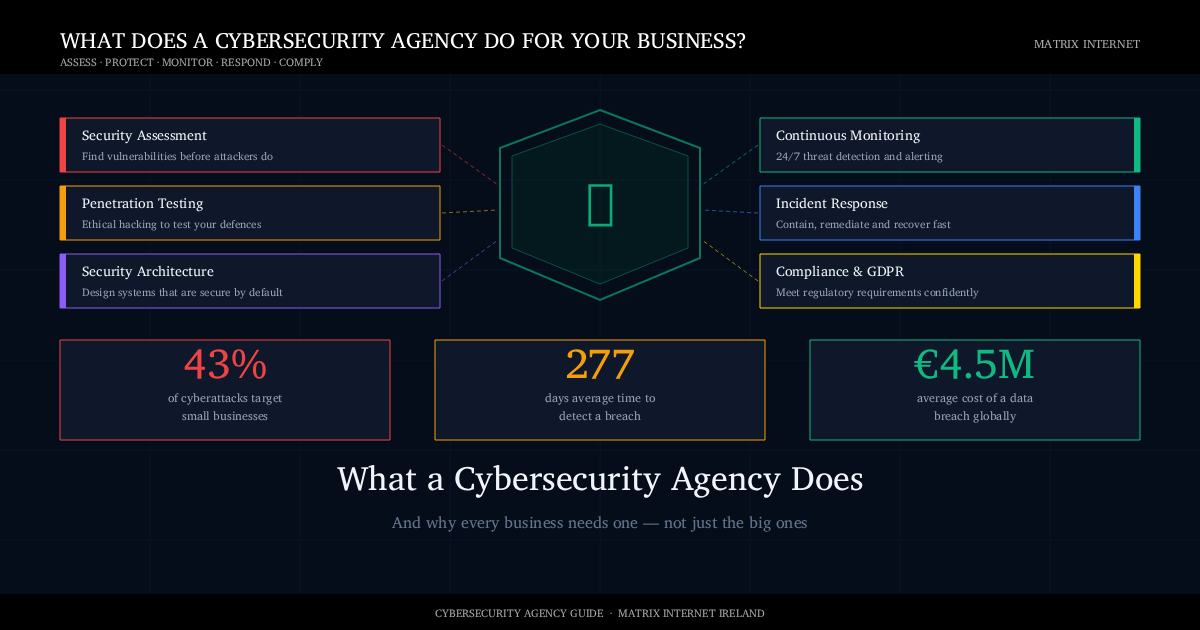
This guide explains what a cybersecurity agency actually does — the core services, how they work in practice, what the relationship looks like, and how to know whether your business needs one. It is written for business owners, not IT teams, because the decision to engage a cybersecurity agency is a business decision as much as a technical one.
Why This Question Matters More Than It Used To
A decade ago, cybersecurity was a concern primarily for banks, hospitals, and government departments — organisations handling the most sensitive data at the largest scale. That picture has changed fundamentally. Automated attack tools have democratised cybercrime: it now costs almost nothing to scan millions of websites for known vulnerabilities and attempt to exploit any that are found, which means the scale of an organisation is no longer a meaningful barrier to being targeted.
According to the Verizon Data Breach Investigations Report, a substantial proportion of confirmed breaches involve small and medium-sized businesses — not because they are specifically targeted, but because they are statistically easier to breach than larger organisations with dedicated security teams. The IBM Cost of a Data Breach report puts the average cost of a breach at over €4.5 million globally — a figure that has risen consistently year on year as regulatory penalties, remediation costs, and reputational damage compound.
At the same time, GDPR has created legal obligations around data protection that apply to virtually every business handling personal data. A breach is no longer just a technical incident — it is a potential regulatory enforcement action, a breach notification obligation, and a reputational event, all simultaneously. This context explains why cybersecurity has moved from a niche IT concern to a mainstream business priority, and why specialist agencies have become a practical necessity for businesses that cannot afford to maintain the expertise in-house.
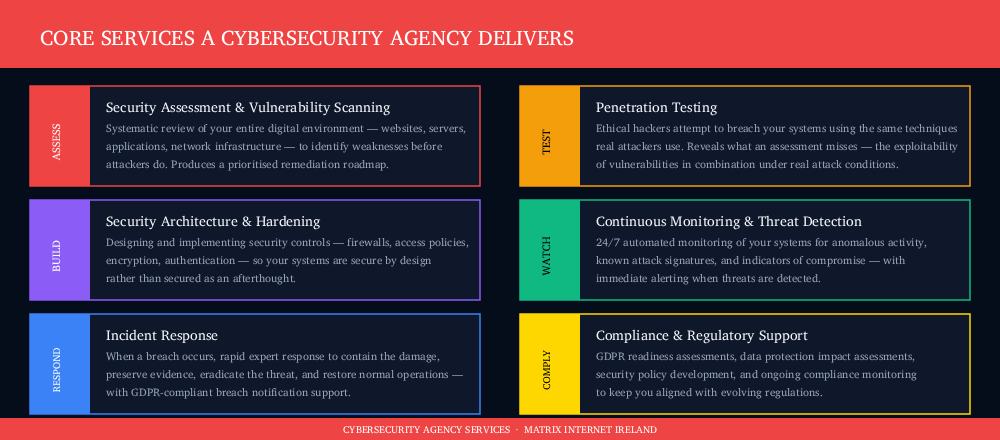
The Core Services a Cybersecurity Agency Delivers
Security assessment and vulnerability scanning
The starting point for almost every cybersecurity agency engagement is understanding the current state of your security — what systems you have, what data they hold, what connections exist between them, and where the vulnerabilities are. A security assessment is a systematic review of your digital environment: websites, web applications, servers, cloud infrastructure, network configuration, email systems, and any third-party services with access to your data.
Automated vulnerability scanning tools identify known weaknesses — outdated software versions, misconfigured systems, exposed services, insecure authentication — and produce a report of findings. A good security assessment goes beyond the automated scan: an experienced security analyst reviews the results to identify which vulnerabilities are genuinely exploitable in your specific context and prioritises them by risk. A long list of vulnerabilities ranked only by technical severity is less useful than a shorter, prioritised remediation roadmap that tells you what to fix first and why.
Penetration testing
A vulnerability assessment tells you what weaknesses exist. A penetration test — or pen test — tells you whether those weaknesses can actually be exploited, and what an attacker could access if they were. Penetration testing involves ethical hackers (security professionals with explicit permission to attempt to breach your systems) using the same techniques, tools, and approaches that real attackers use, to find the paths from the outside world into your systems.
The OWASP Web Security Testing Guide is the industry standard framework for web application penetration testing — covering everything from injection attacks and authentication vulnerabilities to business logic flaws that automated scanning tools cannot detect. A credible penetration test follows a methodology like this, documents its findings clearly, and produces a report that gives your team a clear picture of what was found, how it was found, and what needs to be done to fix it.
Different types of pen tests target different parts of your environment: web application testing for your websites and applications, network testing for your infrastructure, social engineering testing for your people (phishing simulations, phone-based attacks), and physical security testing for premises access. The scope is agreed before the test begins and documented in a formal authorisation to avoid any ambiguity about what is permitted.
Security architecture and hardening
Identifying vulnerabilities is necessary but not sufficient — the vulnerabilities need to be fixed, and the systems need to be configured and maintained in a way that prevents new ones from appearing. Security hardening is the process of reducing the attack surface of your systems: removing unnecessary services and software, applying secure configuration baselines, implementing access controls, enabling encryption, and ensuring that default credentials and settings have been changed.
For businesses building new systems or undergoing digital transformation, a cybersecurity agency can advise on security architecture from the ground up — designing systems so that security is built in rather than bolted on. This includes decisions about network segmentation (separating systems so that a compromise of one does not automatically compromise others), identity and access management (who has access to what and how that access is authenticated and audited), and data protection (how customer data is stored, encrypted, accessed, and retained).
Continuous monitoring and threat detection
Attackers do not work nine to five. A security posture that is only monitored during business hours has an obvious gap — and experienced attackers know this. Continuous security monitoring means automated systems watching your environment around the clock for indicators of compromise: anomalous login behaviour, unusual data transfers, known malware signatures, unexpected changes to files or configurations.
This is typically delivered through a Security Information and Event Management (SIEM) system that aggregates logs from across your environment and applies detection rules and machine learning to identify threats. Many cybersecurity agencies operate a Security Operations Centre (SOC) — a team of analysts who review alerts, investigate suspicious activity, and respond to confirmed threats. For businesses that cannot justify a full-time internal security team, a managed SOC provided by an agency delivers equivalent capability at a fraction of the cost.
Threat intelligence — information about new attack techniques, emerging vulnerabilities, and active threat actors targeting businesses in your sector — is another component of continuous monitoring. Agencies with access to threat intelligence feeds can update their detection capabilities ahead of new threats rather than learning about them after an incident.
Incident response
Despite the best preventive measures, incidents happen. A cybersecurity agency provides incident response capability: the expert team and established processes needed to respond to a breach or attack effectively, minimising damage and recovery time.
Effective incident response follows a structured process: containment (stopping the attack from progressing), eradication (removing the attacker and their tools from your environment), recovery (restoring normal operations from clean backups), and post-incident review (understanding how the attack happened and closing the vulnerabilities it exploited). Without specialist experience, each of these steps takes longer and is more likely to miss things — leaving backdoors the attacker installed, for example, or failing to preserve the evidence needed for regulatory reporting.
Under GDPR, a data breach involving personal data must be reported to the relevant data protection authority within 72 hours of discovery. A cybersecurity agency with incident response experience helps you meet this timeline, assess what data was accessed, and draft the required notifications — reducing the regulatory risk that comes with a breach alongside the technical one. For guidance on recovering from a site compromise, our guide on how to recover a hacked website covers the practical steps in detail.
Compliance and regulatory support
GDPR is the most significant regulatory framework affecting businesses in Ireland and across Europe, but it is not the only one. Payment Card Industry Data Security Standard (PCI-DSS) applies to any business that processes card payments. ISO 27001 is the international standard for information security management systems, increasingly required by enterprise clients and public sector contracts. The NIS2 Directive extends security obligations across a broader range of sectors.
A cybersecurity agency helps businesses understand which regulations apply to them, assess their current compliance gap, and implement the controls needed to meet their obligations. For many businesses, this is one of the most immediately valuable services an agency provides — not because compliance is an end in itself, but because the controls required to achieve compliance are also the controls that substantially improve security posture.
In-House vs Agency: The Practical Reality
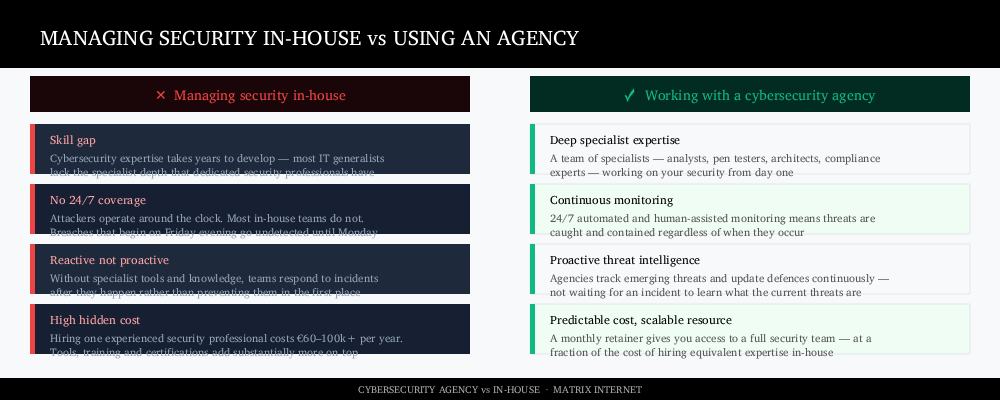
The case for handling security in-house is straightforward: internal knowledge, direct control, and no third-party dependency. The practical reality for most businesses is more complicated.
Cybersecurity is a broad and rapidly evolving field. A single security professional — even an excellent one — cannot maintain deep expertise across offensive security, network security, cloud security, compliance, incident response, and threat intelligence simultaneously. Agencies employ specialists across each of these areas, and their collective expertise is significantly broader than any individual hire.
Cost is a significant factor. Hiring one experienced security engineer costs €60,000 to €100,000 per year in salary alone, before accounting for benefits, training, tools, and the fact that a single person cannot provide 24/7 coverage. A cybersecurity agency engagement provides access to a team of specialists, established tooling, and round-the-clock monitoring at a monthly retainer that is typically a fraction of the equivalent in-house cost.
There is also the question of what happens when a serious incident occurs. An in-house security team facing a sophisticated attack may be encountering techniques they have never seen before. An agency incident response team handles multiple incidents across multiple clients — the pattern recognition and experience that comes from this breadth is difficult to replicate in a single in-house hire.
This does not mean in-house security has no role. For larger organisations, the model that works best is often a small in-house security function working alongside an agency — internal ownership and context combined with external specialist depth and capacity.
Eight Signs Your Business Needs a Cybersecurity Agency
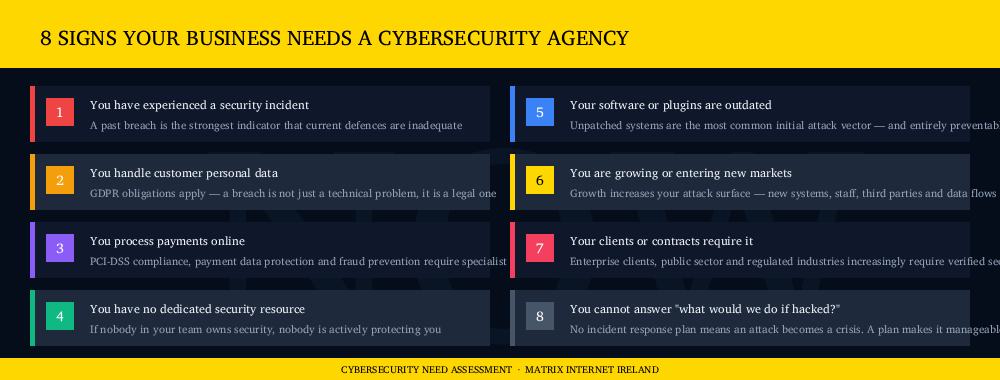
You have experienced a security incident. A past breach — however it was handled — is evidence that your current defences are not sufficient. The vulnerabilities that allowed the first attack may still be present, or related ones may exist. An agency assessment following an incident is the most reliable way to understand what happened and close the gaps it revealed.
You handle customer personal data. If your business collects, stores, or processes personal information about customers — names, email addresses, payment details, health information — you have GDPR obligations that include technical and organisational security measures. An agency helps you meet those obligations and document that you have done so.
You process payments online. Online payment processing creates specific obligations under PCI-DSS and specific attack vectors through which customer financial data can be compromised. Agencies with payment security experience can assess your card data environment and identify the controls needed to reduce risk and meet compliance requirements.
You have no dedicated security resource. If nobody in your organisation has a defined responsibility for security — not as a side responsibility alongside a broader IT or developer role, but as a primary focus — your security posture is being maintained reactively at best and not at all at worst.
Your software and systems are not regularly updated. Outdated plugins, themes, CMS installations, and server software are the most common entry points for attackers. If your update and patch management process is not structured and consistent, an agency can implement and manage it on your behalf. Our guide on how to update WordPress plugins safely covers the basics — an agency takes this further across your entire environment.
You are growing or expanding into new markets. Growth increases your attack surface. New team members, new systems, new third-party integrations, new data flows across borders — each of these introduces potential vulnerabilities that need to be assessed and managed. An agency can stay ahead of this as your business scales.
Your clients or contracts are requiring it. Enterprise clients, public sector organisations, and companies in regulated industries are increasingly requiring their suppliers to demonstrate security standards — through questionnaires, audits, certifications, or contractual requirements. An agency helps you meet these requirements and evidence your security posture credibly.
You cannot answer the question: what would we do if we were hacked tomorrow? If your business has no incident response plan — no documented process for who does what, who gets notified, how systems are restored, and how regulatory obligations are met — then a breach will be far more damaging and prolonged than it needs to be. Developing and testing an incident response plan is one of the most valuable things a cybersecurity agency can help you with before an incident occurs.
What the Relationship Looks Like in Practice
A cybersecurity agency engagement typically begins with an assessment — understanding your current environment, your risk profile, and your priorities. From this, a programme of work is developed that might combine immediate remediation of critical vulnerabilities, a penetration test to validate what the assessment found, implementation of monitoring and detection capability, and a compliance review aligned with your regulatory obligations.
Ongoing engagements are typically structured as a monthly retainer covering continuous monitoring, regular vulnerability scanning, patch management oversight, security advisory, and incident response capability. The specific mix of services is tailored to the size, sector, and risk profile of the business — a thirty-person professional services firm has different needs from a two-hundred-person ecommerce retailer.
Good agencies operate as partners rather than vendors: understanding your business, communicating in terms that make sense to non-technical stakeholders, and helping leadership understand the risk decisions they are making rather than simply producing technical reports that sit unread. The quality of communication and reporting is as important as the technical capability — security is only effective when the people making business decisions understand what the risks are and what is being done about them.
Summary
A cybersecurity agency assesses your vulnerabilities, tests your defences, hardens your systems, monitors your environment continuously, responds to incidents when they occur, and helps you meet your regulatory obligations. It provides the specialist expertise, tooling, and capacity that most businesses cannot cost-effectively maintain in-house — at a predictable monthly cost that scales with what you need.
The question of whether your business needs one is increasingly not whether you can afford it, but whether you can afford not to. The cost of a serious security incident — measured in remediation time, regulatory fines, customer notification, reputational damage, and lost business — typically exceeds the cost of years of prevention. The businesses that understand this early are the ones that avoid the incidents that demonstrate it.
If you want to understand what your current security posture looks like and what a cybersecurity agency could do for your specific business, the security and technical support team at Matrix Internet works with businesses across Ireland and Europe — from initial assessments through to ongoing managed security. Get in touch to start the conversation.
At Matrix Internet, our cybersecurity team helps businesses understand their exposure, close their vulnerabilities, and stay protected — from initial assessment and penetration testing through to continuous monitoring and incident response support.
FAQs
IT support and cybersecurity are related but distinct disciplines. An IT support company manages your technology infrastructure — keeping systems running, fixing problems, setting up hardware and software. A cybersecurity agency specifically focuses on protecting your systems from threats: finding vulnerabilities before attackers do, testing your defences, monitoring for intrusions, and responding when incidents occur. Some IT support companies offer basic security services, but a dedicated cybersecurity agency brings significantly deeper specialist expertise — ethical hackers, security architects, compliance specialists, and incident response professionals — that a general IT support provider typically cannot match. Many businesses benefit from both: IT support for day-to-day operations and a cybersecurity agency for dedicated security expertise.
A penetration test — or pen test — involves ethical security professionals attempting to breach your systems using the same tools and techniques real attackers use, with your explicit permission and within an agreed scope. The purpose is to find the vulnerabilities that automated scanning misses: flaws in business logic, combinations of weaknesses that can be chained together, and human factors like susceptibility to phishing. Whether your business needs one depends on your risk profile. If you process payments, handle significant volumes of personal data, are growing rapidly, or are subject to regulatory requirements, a penetration test should be conducted at least annually. Many enterprise contracts and public sector tenders now require evidence of recent penetration testing as a condition of engagement.
A cybersecurity assessment is a systematic review of your digital environment — websites, web applications, servers, cloud infrastructure, email systems, and internal network — to identify security weaknesses. The process typically involves automated vulnerability scanning tools that identify known weaknesses such as outdated software, misconfigured systems, and insecure authentication, followed by manual analysis from an experienced security professional who interprets the results, removes false positives, and prioritises findings by the actual risk they represent to your business. The output is a report that describes each vulnerability found, its severity, the risk it poses, and the specific steps needed to remediate it — giving your team a clear, prioritised action plan rather than an overwhelming list of technical findings.
Costs vary significantly depending on the scope of services and the size and complexity of your environment. A one-time vulnerability assessment for a small business website might start from a few hundred euros. A comprehensive penetration test of a web application typically ranges from €2,000 to €10,000 depending on scope and complexity. Ongoing managed security services — continuous monitoring, monthly vulnerability scanning, security advisory, and incident response retainer — are typically structured as a monthly fee that scales with the size of the environment being protected. The most useful framing is to compare this cost against the alternative: the average cost of a data breach for a small business runs into hundreds of thousands of euros when remediation, regulatory fines, legal costs, and reputational damage are included. Prevention is consistently cheaper than recovery.
By Matrix Internet


