


BLOG
How to Choose a Cybersecurity Agency in Ireland
4 min read
Choosing the right cybersecurity agency is critical for protecting your business, meeting regulatory requirements, and avoiding costly security risks.
Choosing the wrong cybersecurity agency is worse than choosing no agency at all. A provider that lacks relevant expertise, holds no verifiable certifications, or has no experience navigating Irish regulatory requirements can give you a false sense of security — which is more dangerous than knowing your gaps and managing them consciously. In a market where cybersecurity has become a competitive space attracting providers of wildly varying quality, knowing how to evaluate and select the right agency is a critical business decision.
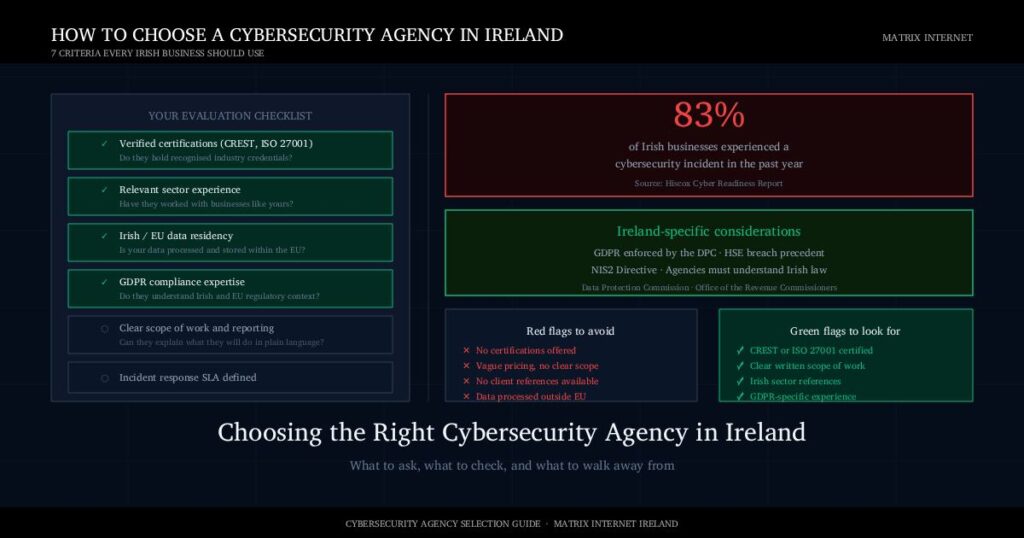
This guide covers the seven criteria that matter most when choosing a cybersecurity agency in Ireland, the questions you should ask before signing anything, the red flags that should make you walk away, and the specific considerations that apply to Irish businesses that do not necessarily apply elsewhere.
Why This Decision Is More Complex in Ireland
Ireland occupies an unusual position in the European cybersecurity landscape. As the European headquarters of many of the world’s largest technology companies — Google, Meta, Apple, Microsoft, Twitter — Ireland is both a significant target for sophisticated threat actors and the jurisdiction in which the Data Protection Commission (DPC) enforces GDPR for many of those organisations. The DPC has established itself as one of the most active GDPR regulators in Europe, issuing multi-million euro fines and setting enforcement precedents that affect businesses of all sizes.
This context means that a cybersecurity agency working with Irish businesses needs to understand not just the technical landscape, but the specific regulatory environment — the DPC’s enforcement approach, the 72-hour breach notification requirement, the interaction between cybersecurity controls and GDPR’s technical and organisational measures, and the implications of the NIS2 Directive for Irish businesses in sectors designated as critical infrastructure.
Not every cybersecurity agency operating in Ireland has this depth of local regulatory knowledge. Some are international providers with limited understanding of Irish-specific requirements. Some are IT generalists who have added cybersecurity services without building specialist capability. Knowing how to distinguish genuine expertise from superficial positioning is what this guide is designed to help you do.
The Seven Criteria That Matter Most
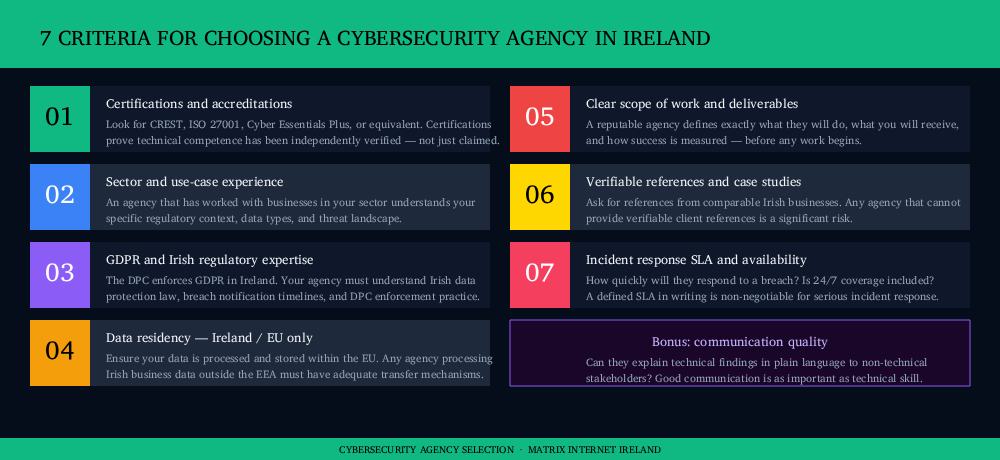
1. Certifications and accreditations
Cybersecurity certifications are not optional credibility markers — they are the mechanism through which technical competence is independently verified. Any agency you engage should hold at least one recognised certification. The most important to look for are:
CREST accreditation is the gold standard for penetration testing providers. CREST-accredited firms have demonstrated technical competence through independent assessment and operate under a code of conduct. If you are commissioning penetration testing — and you should be — CREST accreditation in the testing provider is a minimum requirement, not a bonus.
ISO 27001 certification demonstrates that an organisation has implemented a structured information security management system that has been independently audited. An agency that is ISO 27001 certified practices what it preaches — their own security has been externally assessed and found to meet the standard.
Cyber Essentials Plus is a UK government-backed certification scheme that has been adopted by some Irish providers. It is a useful baseline indicator but less comprehensive than CREST or ISO 27001 for specialist cybersecurity services.
When you ask an agency about certifications, pay attention to how they answer. A confident, specific answer — “we are CREST-accredited for infrastructure testing and web application testing, and we hold ISO 27001 for our managed security services” — is reassuring. Vague responses about “following best practices” or “being aligned with industry frameworks” without naming specific certifications should prompt further scrutiny.
2. Relevant sector and use-case experience
Cybersecurity is not a domain-agnostic discipline. The threat landscape, regulatory obligations, and data types facing a financial services firm are different from those facing a healthcare provider, an ecommerce retailer, or a professional services firm. An agency that has worked extensively in your sector will understand the specific risks you face, the compliance frameworks that apply to you, and the types of attacks that are most likely to target organisations like yours.
Ask specifically about sector experience. Ask whether they have worked with businesses of your size. Ask what the most common security issues are that they see in businesses like yours. A good agency will be able to give you specific, substantive answers. A poor one will give you generic responses that could apply to any industry.
3. GDPR and Irish regulatory expertise
This is the criterion that most distinguishes genuinely Irish-capable agencies from providers who are simply operating in the Irish market without specific local expertise. GDPR compliance is a technical and legal obligation that interacts directly with cybersecurity at multiple points — the requirement for appropriate technical and organisational measures, the 72-hour breach notification to the DPC, the data protection impact assessment process, and the documentation requirements that must be available if the DPC requests them.
An agency that cannot speak knowledgeably about the DPC’s enforcement approach, that does not understand what constitutes a reportable breach under GDPR, or that cannot help you understand your breach notification obligations is missing a critical component of what Irish businesses actually need. This knowledge should come up naturally in the engagement process — if you have to drag it out of them, that tells you something.
4. Irish and EU data residency
Any cybersecurity engagement involves the agency having access to information about your systems, potentially including sensitive data. Where that data is processed and stored matters. Under GDPR, the transfer of personal data outside the European Economic Area is restricted unless adequate protection mechanisms are in place. Some international cybersecurity providers process data in the United States, UK, or other third countries — which creates data transfer obligations that must be properly managed.
Ask explicitly where your data will be processed and stored. The answer should be within the EU or EEA. If an agency is routing data through third countries, they must have Standard Contractual Clauses or an equivalent mechanism in place, and they should be able to show these to you. If they cannot give you a clear answer about data location, that is a significant concern.
5. Clear scope of work and deliverables
A reputable cybersecurity agency will define precisely what they are going to do, what you will receive as output, how long it will take, and how success is measured — before any work begins. This should be documented in a Statement of Work or equivalent document that both parties sign.
Be cautious of agencies that propose vague “security packages” or that resist committing to specific deliverables in writing. Cybersecurity engagements can be complex and genuinely variable — but the scope of what is agreed should be explicit, not left to interpretation. If something is out of scope, it should be clearly stated as such. Hidden limitations discovered mid-engagement are a sign of poor initial scoping or deliberate ambiguity.
6. Verifiable client references
References from comparable Irish businesses are one of the most reliable indicators of an agency’s actual performance. Not testimonials on a website — actual contacts you can call or email, who will speak to their experience of working with the agency, the quality of their work, the accuracy of their findings, and how they perform under pressure.
Ask for references from businesses of similar size and sector to yours. A provider that has only worked with large enterprises may not be well-equipped for the different risk profile and budget constraints of an SME. A provider whose only references are in an unrelated sector cannot speak to your specific needs. Any agency that cannot provide verifiable references should be treated with significant caution.
7. Incident response SLA and availability
Attackers do not work business hours, and neither do serious incidents. The question of how quickly an agency will respond to a confirmed breach — and what that response looks like in practice — is one of the most important things to establish before you need it.
A clearly defined incident response Service Level Agreement should specify: what constitutes a critical incident, what the response time commitment is (typically four hours or less for critical incidents), what the escalation path looks like, who your named contact is, and whether out-of-hours coverage is included. This should be in writing as part of your contract. Verbal assurances about being “available when you need us” are not an SLA.
Red Flags and Green Flags
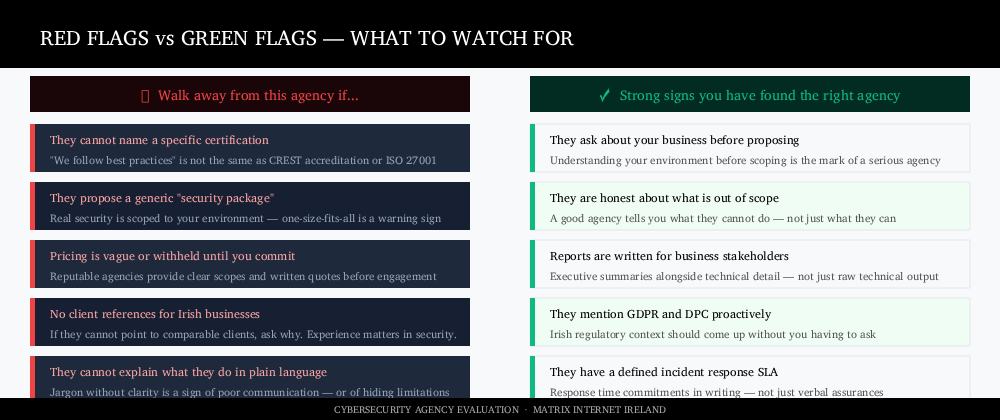
In the evaluation process, certain signals reliably indicate whether an agency is genuinely capable or positioning beyond its actual expertise.
Walk away if: they cannot name specific certifications when asked directly; they propose identical “packages” to every client without scoping your specific environment first; their pricing is vague or only revealed under pressure; they cannot provide references from comparable Irish clients; their reporting samples are dense technical documents with no executive summary; they are evasive about where your data will be processed; or they promise results that sound too comprehensive to be credible for the quoted price.
Strong positive indicators: they ask more questions than they answer in the first meeting; they are honest about what falls outside their scope or capability; they bring up GDPR and DPC requirements without being prompted; their sample reports are clearly written and accessible to non-technical stakeholders; they have a named account manager and a defined escalation path; and they can explain their methodology clearly in plain language.
Ten Questions to Ask Before You Sign
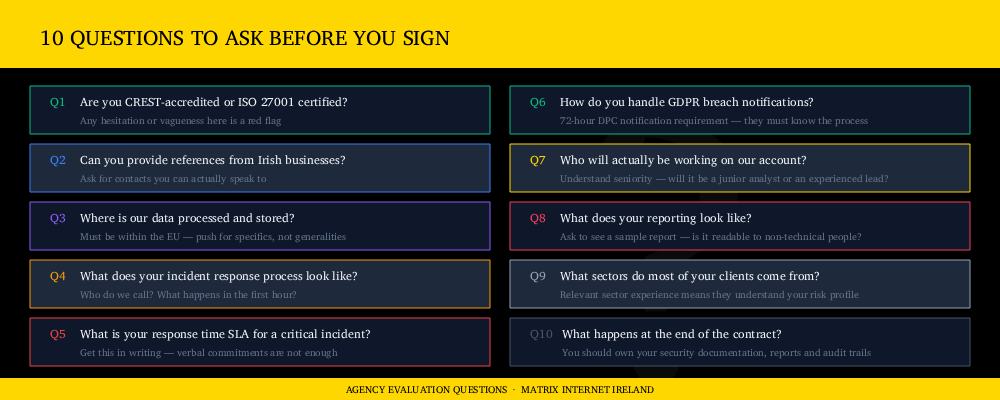
The following questions should be asked of any cybersecurity agency you are seriously evaluating. How they answer tells you as much as what they answer.
Are you CREST-accredited or ISO 27001 certified? The answer should be immediate, specific, and verifiable. Ask for the certificate number or accreditation reference so you can confirm it independently.
Can you provide references from Irish businesses of comparable size? Push for contacts you can actually speak to, not just names on a list. The conversation with a reference will tell you far more than the reference’s name alone.
Where exactly will our data be processed and stored? Specific data centre location or cloud region within the EU. If they cannot answer this precisely, that is a data governance problem.
What does your incident response process look like in the first hour? They should be able to walk you through containment, communication, and evidence preservation in concrete terms — not just tell you they will “mobilise a team.”
What is your response time SLA for a critical incident, and is out-of-hours coverage included? Get the specific commitment in writing. Four hours is a reasonable expectation for a critical incident SLA; anything vaguer than a defined timeframe is not an SLA.
How do you handle GDPR breach notification support? They should know that the DPC must be notified within 72 hours of becoming aware of a reportable breach, understand what constitutes a reportable breach, and be able to support you in drafting the notification. If they are vague on any of this, they are not equipped for Irish regulatory requirements.
Who will actually be working on our account day to day? Understand seniority, qualifications, and experience. The person who presents in the pitch meeting is not always the person who does the work. Ask to meet the delivery team, not just the sales team.
Can I see a sample report from a comparable engagement? Anonymised is fine. Look for: is it readable? Does it have an executive summary? Are findings prioritised by risk, not just technical severity? Are remediation steps specific and actionable?
What sectors do most of your clients come from, and do you have experience in my sector? This reveals whether their experience is relevant. An agency that works primarily with financial services firms will bring a different — and potentially more useful — perspective to a financial services engagement than a generalist.
What happens to our security documentation and audit trails at the end of the engagement? You should own your security documentation. Ensure the contract specifies that reports, findings, and audit evidence are your property and will be handed over in full at contract end.
Understanding Pricing: What to Expect and What to Be Wary Of
Cybersecurity pricing varies significantly based on scope, complexity, and the specific services involved. A one-time vulnerability assessment for a small business website starts from a few hundred euros. A comprehensive web application penetration test typically ranges from €2,000 to €10,000. Ongoing managed security services — continuous monitoring, monthly scanning, advisory, and incident response retainer — are priced on a monthly retainer that scales with the environment being protected.
Be wary of pricing that seems too low for what is being promised. Cybersecurity expertise is expensive. A penetration test that costs a few hundred euros is not being delivered by an experienced ethical hacker using professional tooling — it is either a superficial automated scan being sold as a pen test, or the agency is cutting corners in ways that will limit the value of the findings.
Be equally wary of bundled “all-in” pricing without clear breakdown of what is included. Understanding what you are paying for — and being able to verify that you are receiving it — requires scope transparency that vague bundles do not provide.
The most useful framing for cybersecurity investment is comparison against the cost of a breach. The IBM Cost of a Data Breach report puts the average cost of a breach at over €4.5 million globally, including remediation, regulatory fines, legal costs, and reputational damage. For an Irish SME, the proportionate cost of a serious breach — measured in DPC fines, customer notification, emergency remediation, and lost business — consistently exceeds annual security investment by a significant multiple. Prevention is the better economic case as well as the better security one.
The Importance of Fit, Not Just Capability
Technical capability is necessary but not sufficient. The agency you choose will need to communicate security issues to non-technical leadership, work within your operational constraints, and operate as a trusted partner rather than a vendor. The relationship matters.
In the initial engagement meetings, pay attention to how they communicate. Do they speak in plain language when addressing business stakeholders, or do they default to technical jargon? Do they listen as much as they talk? Do they ask questions that suggest genuine interest in understanding your business? Are they willing to be honest about limitations, or do they promise everything?
A cybersecurity agency that is technically excellent but communicates poorly will produce reports that are not acted on, findings that are not understood, and recommendations that remain unimplemented — which ultimately means their work has limited real-world security impact regardless of its technical quality.
Summary
Choosing a cybersecurity agency in Ireland requires evaluating technical capability, Irish regulatory expertise, data governance practices, communication quality, and commercial transparency simultaneously. The seven criteria — certifications, sector experience, GDPR expertise, data residency, scope clarity, verifiable references, and incident response SLA — provide a structured framework for this evaluation. The ten questions cut through positioning to reveal actual capability.
The Irish market has no shortage of providers claiming cybersecurity expertise. What distinguishes agencies that will genuinely improve your security posture from those that will not is whether their capability is verifiable, their Irish regulatory knowledge is specific and current, and their communication is clear enough that their findings actually drive action.
If you would like to understand what a cybersecurity assessment from an Irish-based, experienced security team looks like in practice, the cybersecurity and technical support team at Matrix Internet works with businesses across Ireland and Europe. We are happy to answer the questions in this guide about our own practice — including certifications, data residency, GDPR expertise, and incident response SLA — and to scope an engagement that is right for where your business is now. Get in touch to start the conversation.
At Matrix Internet, our cybersecurity team helps businesses understand their exposure, close their vulnerabilities, and stay protected — from initial assessment and penetration testing through to continuous monitoring and incident response support.
FAQs
The two most important certifications to look for are CREST accreditation and ISO 27001 certification. CREST is the industry-recognised standard for penetration testing providers — it confirms that the agency's ethical hackers have been independently assessed for technical competence and operate under a professional code of conduct. ISO 27001 confirms that the agency has implemented a structured information security management system that has been externally audited. Beyond these, Cyber Essentials Plus is a useful baseline indicator. Any agency that cannot point to at least one of these certifications by name, with a verifiable reference number, should be treated with caution regardless of how confident their sales pitch sounds.
Not necessarily — competent cybersecurity agencies can work with Irish businesses remotely, and many engagements do not require physical presence. However, the agency must have genuine expertise in Irish-specific regulatory requirements: GDPR as enforced by the Data Protection Commission, the 72-hour breach notification timeline, the NIS2 Directive obligations for relevant sectors, and the specific enforcement approach the DPC has taken in Ireland. They must also ensure that any personal data processed during the engagement remains within the EU or EEA. An agency based outside Ireland that lacks this regulatory depth — or that processes your data in the US or UK without adequate transfer mechanisms — is not fully equipped for the Irish regulatory context, regardless of their technical capability.
For a small to medium-sized business — a website, standard cloud infrastructure, and a modest internal network — a vulnerability assessment typically takes one to two weeks from commencement to delivery of the final report. A penetration test of a web application takes two to four weeks depending on scope and complexity. Ongoing managed security services begin with an onboarding assessment and are then continuous from that point. Timeline depends significantly on the scope agreed at the outset and on how quickly you can provide the access and information the agency needs to begin. A well-run agency will give you a specific timeline at scoping and flag any dependencies that could affect delivery.
A vulnerability assessment is a systematic scan of your systems to identify known weaknesses — outdated software, misconfigured settings, exposed services, insecure authentication. It tells you what weaknesses exist. A penetration test goes further: ethical hackers actively attempt to exploit those weaknesses using real attack techniques, to determine whether they can actually be leveraged to access your systems and what an attacker could reach if they were. The penetration test reveals exploitability, which the assessment alone cannot confirm. For most businesses, the appropriate sequence is a vulnerability assessment first to establish the landscape, followed by a penetration test to validate the most critical findings under realistic attack conditions.
By Matrix Internet


