


BLOG
Shared vs VPS vs Dedicated Hosting — Which Is Right for You?
4 min read
Matrix is proud to join PACE, now launched in Moldova. The Erasmus+ project strengthens youth organisations across the region with training, digital resources and collaboration to support displaced Ukrainian young people.
Choosing the wrong hosting plan is one of the most expensive mistakes a growing business can make — and most people make it not through ignorance, but through inertia. You sign up for cheap shared hosting when you launch, your site grows, and by the time performance problems start eroding your conversion rate and your search rankings, the damage is already accumulating. The question of which hosting type is right for you is not a one-time decision. It is one you need to revisit as your business changes.
This guide breaks down the three main hosting options — shared, VPS, and dedicated — in plain terms, compares them honestly, and gives you a clear framework for deciding which one your site needs right now.
The Fundamentals: What You Are Actually Paying For
Before comparing hosting types, it helps to understand what web hosting actually is. When you host a website, you are renting space on a physical server — a computer permanently connected to the internet — that stores your site’s files and delivers them to visitors when they request them. The type of hosting you choose determines how much of that server’s resources you get, and crucially, who else is sharing them with you.
Every hosting type involves trade-offs between cost, performance, control, and complexity. There is no universally correct answer — the right choice depends on your traffic volumes, technical requirements, budget, and how much risk you are willing to accept around performance and security.
Shared Hosting: The Budget-Friendly Entry Point
Shared hosting is exactly what the name suggests. Your website sits on a server alongside potentially hundreds of other websites, all sharing the same pool of CPU, RAM, and bandwidth. The hosting provider manages the server infrastructure, the operating system, and the software stack. You simply upload your site and use it.
The appeal is obvious: shared hosting is extraordinarily cheap. Plans from providers like SiteGround, Bluehost, and Hostinger typically start between €3 and €10 per month, include one-click WordPress installation, free SSL, and basic email hosting. For someone launching a first website or running a small blog, shared hosting is a perfectly sensible starting point.
The limitations become apparent as traffic grows. Because resources are shared, a traffic spike on one site on the server affects everyone else on it — a problem commonly called the noisy neighbour effect. If the site next to yours experiences a surge in visitors, your site may slow down or become temporarily unavailable through no fault of your own. You also have no control over the server configuration — you cannot install custom software, change PHP settings beyond basic parameters, or adjust anything at the server level. Security is also weaker by nature: a vulnerability in one site on the shared server can, in some circumstances, be exploited to access others.
According to Google’s web performance research, a one-second delay in page load time can reduce conversions by up to 20%. For a site on shared hosting that regularly hits resource limits, this is not an academic concern — it is a direct revenue impact.
VPS Hosting: The Middle Ground That Most Growing Businesses Need
A Virtual Private Server (VPS) is a single physical server that has been partitioned into multiple isolated virtual machines using software called a hypervisor. Each virtual machine — each VPS — behaves exactly like a standalone server, with its own dedicated allocation of CPU, RAM, and storage that cannot be consumed by other users on the same physical machine.
This distinction is critical. On shared hosting, resources are pooled — when demand spikes elsewhere, your allocation shrinks. On a VPS, your allocation is guaranteed. If your plan includes 4GB of RAM, you have 4GB of RAM, regardless of what the other virtual machines on the physical server are doing. This predictability is what makes VPS hosting the right choice for businesses that have outgrown shared hosting but do not need the expense of a dedicated server.
Providers like DigitalOcean, Linode (now Akamai Cloud), and Vultr have made unmanaged VPS hosting accessible and affordable, with plans starting from around €5–10 per month for entry-level configurations. Managed VPS options — where the provider handles server maintenance, security updates, and monitoring — cost more but are often the right choice for businesses without in-house technical expertise.
VPS hosting gives you root access to your server, which means you can install any software, configure any setting, and build any environment your application requires. Running a WooCommerce store with specific PHP version requirements? A Node.js application? A custom database configuration? All of this is possible on a VPS in a way that simply is not on shared hosting.
The trade-off is complexity. Managing a VPS requires at least basic Linux system administration knowledge, or the willingness to pay for a managed service. If neither of those is in place, a poorly configured VPS can be less secure than well-managed shared hosting. This is where managed technical support services become valuable — the performance and control of a VPS without the burden of managing it yourself.
Dedicated Hosting: Maximum Performance, Maximum Control
A dedicated server is an entire physical machine rented exclusively for your use. There are no other tenants, no shared resources, and no noisy neighbours. Everything — every byte of RAM, every CPU cycle, every megabyte of storage — is yours.
This delivers performance that shared and VPS hosting cannot match at scale. Dedicated servers can handle extremely high traffic volumes without degradation, can be configured with precisely the hardware specifications your application requires, and offer the highest possible level of security through complete physical and software isolation.
Dedicated hosting is the standard choice for large e-commerce platforms, high-traffic media sites, enterprise applications, and any business operating under strict data compliance requirements — GDPR, PCI-DSS for payment processing, or sector-specific regulations in healthcare and financial services. When data isolation is a legal requirement rather than a preference, a dedicated server is often the appropriate solution.
The cost reflects this premium. Dedicated server plans from providers like OVH and Hetzner typically start at €80–150 per month for entry-level hardware, rising to €500 or more for high-specification configurations. Add managed services, and costs increase further — though for businesses at the scale where dedicated hosting makes sense, the cost is readily justified by the performance and compliance benefits.
Managing a dedicated server without technical expertise is not advisable. Root-level access to a physical server means that misconfiguration can cause serious problems — security vulnerabilities, data loss, or extended downtime. Managed dedicated hosting, where a provider handles ongoing maintenance and monitoring, is the realistic option for most businesses without a dedicated DevOps team.
A Direct Comparison
The choice between hosting types rarely comes down to a single factor. Here is how the three options stack up across the dimensions that matter most for most businesses:
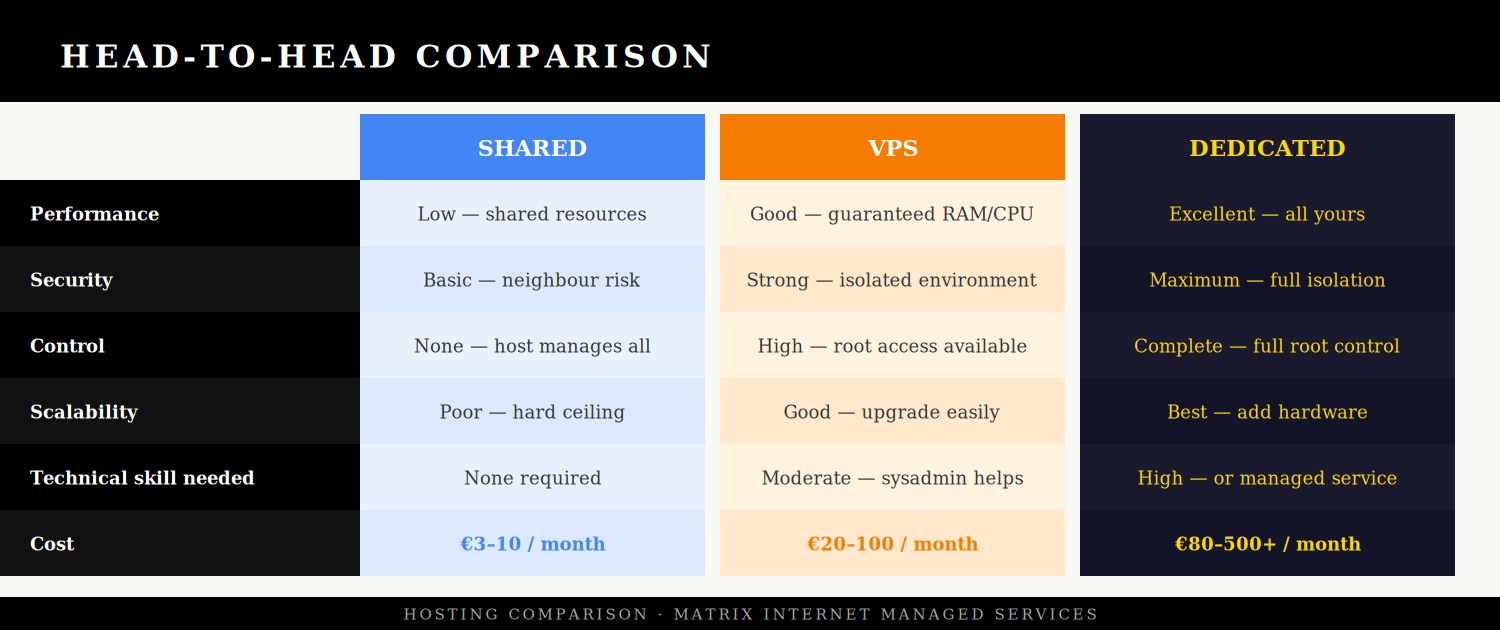
Performance. Shared hosting is adequate for low-traffic sites but degrades unpredictably under load. VPS delivers consistent, guaranteed performance within its allocated resources. Dedicated hosting delivers the maximum possible performance for a given hardware specification, with no resource contention of any kind.
Security. Shared hosting carries inherent cross-tenant risk — your security is partially dependent on the security practices of other sites on the server. VPS isolation eliminates this: a compromise on one virtual machine does not affect others. Dedicated hosting offers complete physical isolation, making it the appropriate choice for sites handling sensitive personal, financial, or health data.
Control. Shared hosting gives you essentially no server-level control. VPS gives you full root access within your virtual machine. Dedicated hosting gives you complete control over every aspect of the physical and software environment.
Scalability. Shared hosting has a hard ceiling — you cannot scale beyond what the shared plan allows without migrating. VPS plans can typically be upgraded within minutes by allocating more resources to your virtual machine. Dedicated servers scale by adding or upgrading hardware, which requires planning and potentially some downtime.
Cost. Shared hosting wins on cost absolutely. VPS offers significantly better value than shared hosting at the performance tier where it operates. Dedicated hosting is the most expensive option and is only cost-effective at the scale and requirements level that genuinely needs it.
Five Signs You Need to Upgrade Your Hosting
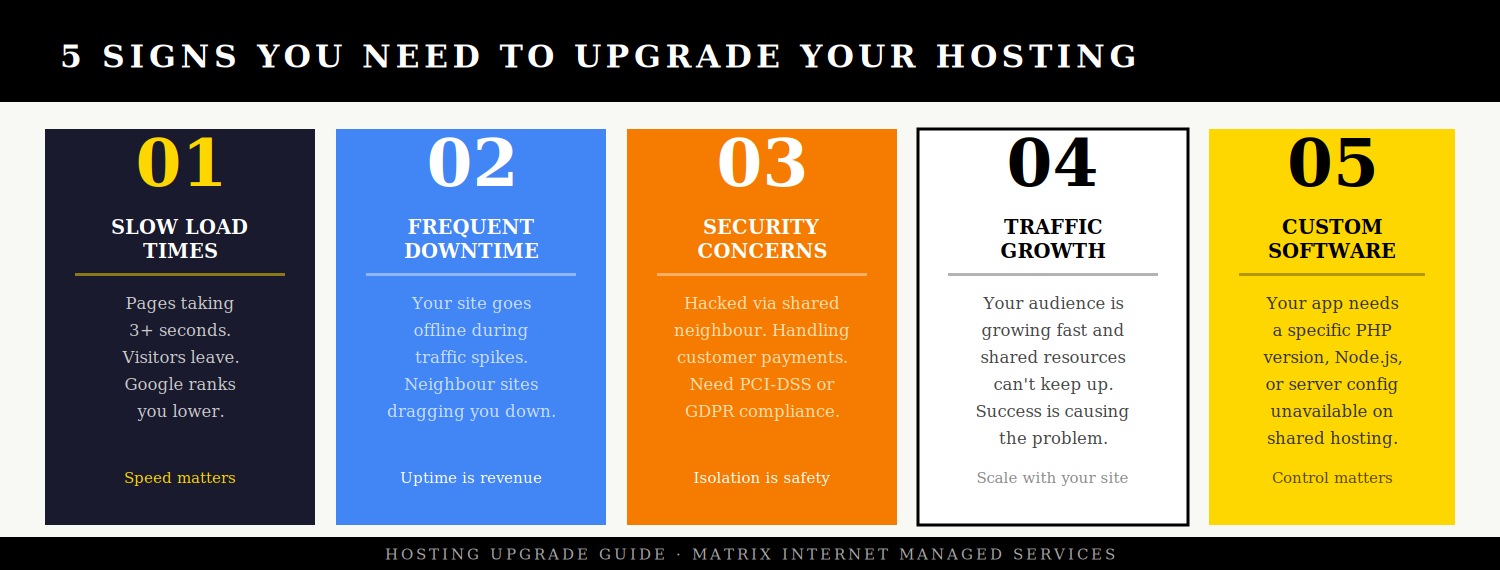
Most businesses stay on their current hosting plan too long. The signs that it is time to upgrade are often gradual — a slightly slower site, an occasional timeout, a sporadic error message — and it is easy to attribute these to other causes. Here are the clear indicators that your hosting has become a bottleneck:
Your page load times are consistently above two seconds. Google’s Core Web Vitals use Largest Contentful Paint (LCP) as a primary ranking signal, and sites that load slowly are penalised in search rankings, as well as losing visitors to impatience. If your load times are above two seconds and your image optimisation and caching are already in place, your hosting infrastructure is almost certainly the limiting factor.
Your site goes down during traffic peaks. If your site becomes unavailable when you run a promotion, send an email campaign, or get featured in press coverage, your shared hosting plan cannot handle the demand. This is not a technical problem that can be optimised away — it is a resource constraint that requires more resources.
You have experienced a security incident traceable to shared hosting. If your site has been compromised through a vulnerability in a neighbouring account, or if you are about to start accepting payments or storing sensitive customer data, the security model of shared hosting is no longer appropriate.
Your development requirements exceed what shared hosting allows. If your site or application needs a specific software stack — a particular PHP version, Node.js, Redis, custom cron jobs, or any server-level configuration — and your shared host cannot provide it, a VPS is the straightforward solution.
Your business depends on your website being available. If downtime on your website means lost revenue in a direct and measurable way — you run an e-commerce store, a booking platform, or a subscription service — the reliability ceiling of shared hosting is a business risk, not just a technical inconvenience.
What About Managed Hosting and Cloud Hosting?
Two other hosting categories deserve mention because they are increasingly relevant for businesses that want better performance without managing infrastructure themselves.
Managed WordPress hosting — from providers like Kinsta, WP Engine, and SiteGround’s managed plans — sits between VPS and dedicated in terms of performance and cost, and is specifically optimised for WordPress. These providers handle server management, automatic updates, daily backups, and performance optimisation, making them the right choice for businesses running WordPress at scale who do not want to manage server infrastructure themselves.
Cloud hosting from providers like AWS, Google Cloud, and Microsoft Azure distributes your site across multiple physical servers, eliminating the single point of failure that all traditional hosting types share. Cloud hosting scales dynamically — you pay for what you use, and resources expand automatically during traffic spikes. For applications with highly variable or unpredictable traffic patterns, cloud infrastructure is increasingly the standard choice.
Making the Decision
The decision framework is straightforward once you have an honest picture of where your site currently stands and where it is heading.
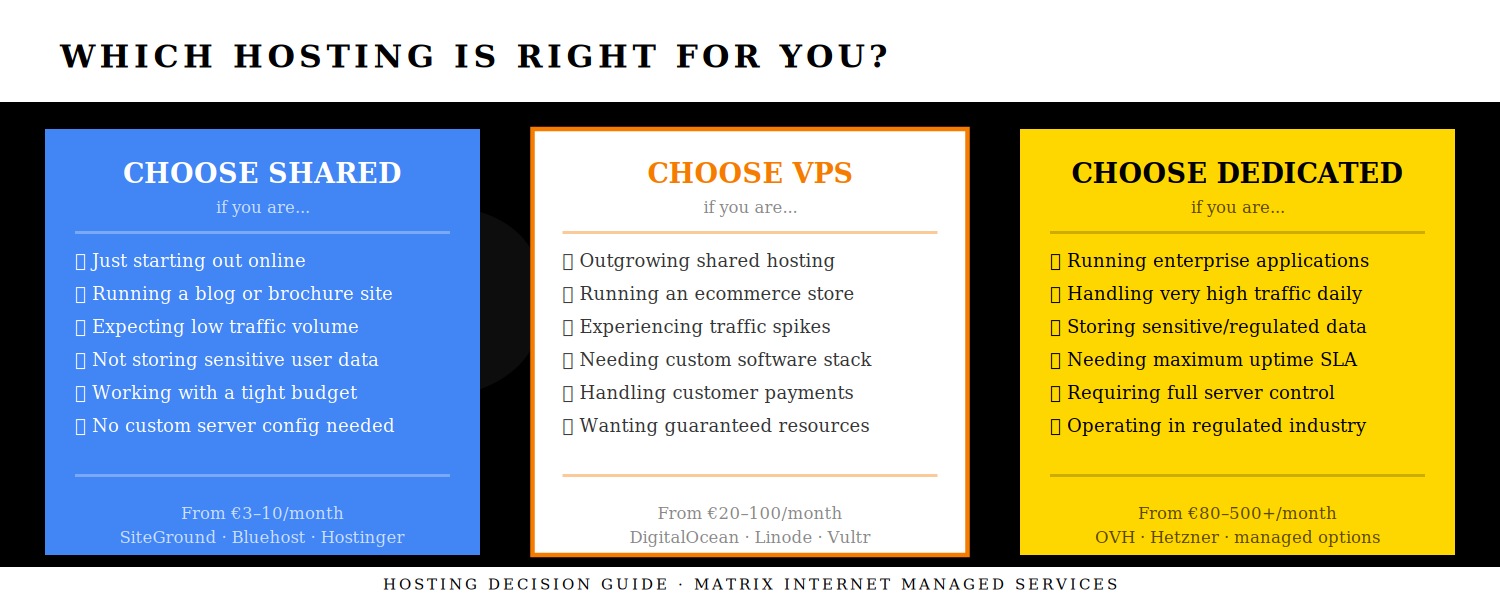
If you are running a personal site, a small blog, a simple brochure site with low traffic, or you are just starting out, shared hosting is the right starting point. It is cheap, easy, and adequate for the scale you are at. Choose a reputable provider rather than the cheapest possible option, and you will have a solid foundation.
If your site is growing, you are running e-commerce, you are handling customer data, you need consistent performance, or you have specific software requirements — a VPS is almost certainly the right move. The jump in cost from shared to VPS is modest; the jump in performance, reliability, and control is significant. The question is not usually whether to make this move, but when.
If your business depends on its website at a level where downtime is a major operational or financial event, you are handling regulated data, or you are running applications at a large scale, dedicated hosting or cloud infrastructure is the appropriate solution, ideally with a managed service layer that handles the technical complexity.
If you are not sure where your site falls on this spectrum, or if you want an expert assessment of whether your current hosting is appropriate for your needs, the managed technical support team at Matrix Internet can review your setup and make concrete recommendations. Getting hosting right is foundational — almost every other performance and security decision you make sits on top of it.
Summary
Shared hosting is affordable and appropriate for small, low-traffic sites where performance predictability is not critical. VPS hosting is the right choice for most growing businesses — it delivers guaranteed resources, full server control, and the flexibility to scale, at a price point that is accessible for most budgets. Dedicated hosting is reserved for high-scale, high-stakes operations where performance, security, and control cannot be compromised.
The worst outcome is staying on a hosting plan that has become a bottleneck — paying the cost in slow load times, search ranking penalties, and lost conversions, while the correct solution is relatively straightforward. Review your hosting as part of your regular technical audit, treat it as infrastructure rather than an afterthought, and make sure the foundation your website sits on is appropriate for the business it is serving. For ongoing server management, security monitoring, and technical support across all hosting environments, the Matrix Internet managed services team is available to help.
At Matrix Internet, our technical support team helps businesses find and fix broken links quickly — auditing your site, setting up the right redirects, and putting monitoring in place to stop dead links from damaging your SEO and user experience.
FAQs
On shared hosting, your website shares a server's CPU, RAM and bandwidth with hundreds of other sites. If one of those sites experiences a traffic spike, your site slows down too. A VPS (Virtual Private Server) partitions the same physical server into isolated virtual machines, each with a guaranteed allocation of resources that cannot be consumed by other users. You get dedicated RAM and CPU, full root access to configure your environment, and none of the noisy neighbour instability that affects shared hosting. The practical difference shows up most clearly under load — a VPS performs predictably, a shared plan often does not.
The clearest signals are consistent slow load times despite having caching and image optimisation in place, site downtime during traffic spikes such as email campaigns or promotions, a security incident traced to a shared server neighbour, or a requirement to run custom software that your shared host cannot support. If your website is generating direct revenue — through e-commerce, bookings, or subscriptions — and downtime or slow performance has a measurable cost, that is the moment shared hosting becomes a business risk rather than a technical inconvenience. Most growing businesses should make this move before problems become obvious rather than after.
Unmanaged VPS hosting requires at least basic Linux system administration knowledge — you are responsible for installing software, configuring security, applying updates, and monitoring the server yourself. If that is not within your team's capability, a managed VPS is the practical alternative. With a managed plan, the hosting provider or a managed services partner handles server maintenance, security patching, and monitoring, leaving you with the performance and control benefits of a VPS without the operational burden. This is the option most businesses without a dedicated DevOps team should choose.
For most small businesses, no — the cost of dedicated hosting is difficult to justify when a well-configured VPS delivers the performance and reliability needed at a fraction of the price. Dedicated hosting becomes genuinely worth it when you are handling very high traffic volumes that exceed what a VPS can reliably serve, storing regulated or sensitive data that requires complete physical isolation, or operating under compliance requirements such as PCI-DSS for payment processing or sector-specific data regulations. If none of those apply, a managed VPS is almost always the better value proposition.
By Srdjan


