


BLOG
LinkedIn Advertising: Why It Remains the Most Effective B2B Paid Channel
4 min read
Matrix is proud to join PACE, now launched in Moldova. The Erasmus+ project strengthens youth organisations across the region with training, digital resources and collaboration to support displaced Ukrainian young people.
There is a version of this conversation that ends with someone pointing at LinkedIn’s cost per click — typically €5 to €10, meaningfully higher than Google or Meta — and deciding the platform is too expensive. That decision is understandable and, for B2B marketing, usually wrong. The cost-per-click comparison misses the point of LinkedIn entirely. The right question is not what does a click cost, but who is clicking and how likely are they to buy.
LinkedIn’s dominance in B2B advertising is not a preference or a fashion. It is the structural consequence of one fact: it is the only platform where business decision-makers are the primary audience, not an incidental segment. Everything that makes LinkedIn advertising expensive also makes it effective — and the data, increasingly, shows that effectiveness in hard commercial terms.
The Audience Problem That LinkedIn Solves
B2B purchasing decisions are not made by algorithms or by general populations. They are made by specific people in specific roles — procurement managers, CTOs, marketing directors, managing partners, finance leads — who have budgets, decision-making authority, and a professional context that shapes what they buy and why. Reaching these people through advertising has historically been one of the most expensive and imprecise activities in marketing.
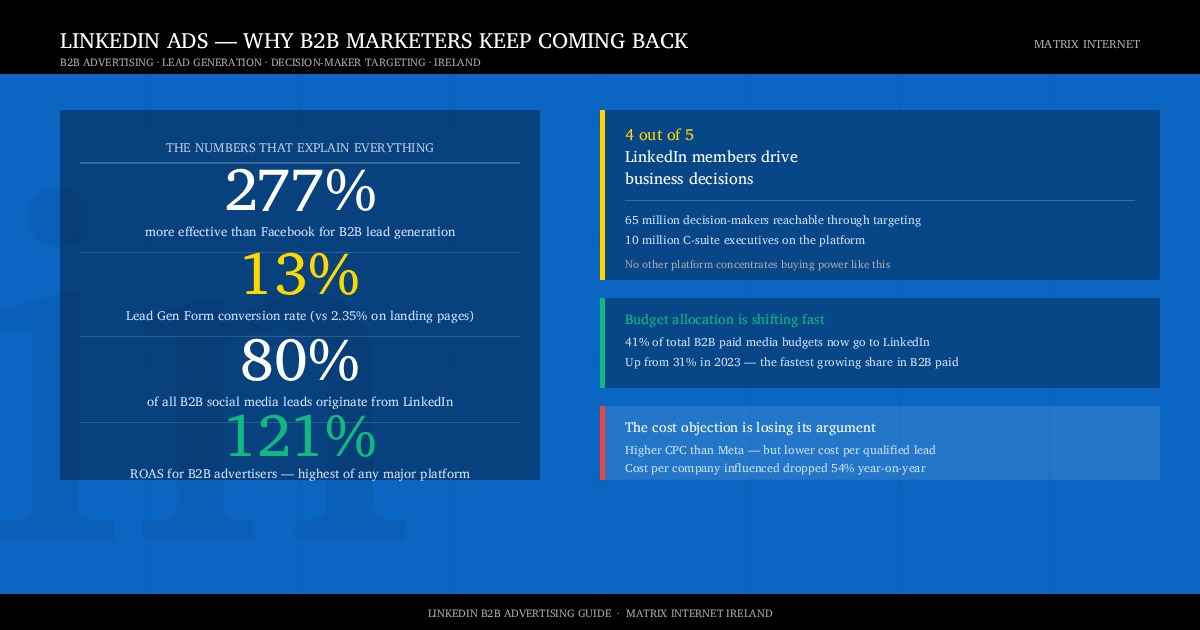
LinkedIn solves the audience problem structurally. Four out of five LinkedIn members drive business decisions in their organisations. The platform has 65 million decision-makers and 10 million C-level executives reachable through its targeting system — not estimated, not inferred from interest data, but identified through the professional profile information members actively maintain because their careers depend on it being accurate.
This is the distinction that matters. When you target “marketing directors in Ireland” on Meta, you are targeting people whose Facebook profile suggests they might be marketing directors. When you target the same group on LinkedIn, you are targeting people whose LinkedIn profiles, employment histories, and professional networks confirm they are. The data quality underlying the targeting is categorically different, and it is why LinkedIn generates 80% of all B2B social media leads — not because it is the largest social network, but because it concentrates the right people.
The Numbers That Changed the Conversation
For years, LinkedIn advertising’s reputation was built on audience quality but undermined by performance data that was hard to attribute. B2B purchase cycles are long, involve multiple stakeholders, and do not convert neatly within a single-session attribution window. A CFO who sees a LinkedIn ad in January and signs a contract in June looks like a non-converting impression in most standard reporting.
The data infrastructure to measure this properly has now matured, and what it shows has shifted the conversation significantly. The Dreamdata LinkedIn Ads Benchmarks Report 2026, built on data from more than 66 million sessions across 3.5 million complete B2B customer journeys, puts LinkedIn’s ROAS for B2B advertisers at 121% — the highest of any major advertising platform, ahead of Google Search at 98% and Meta at 104%.
The cost per company influenced — defined as the cost of reaching a target account where at least one stakeholder had contact with an ad — dropped from €154 to €70 on LinkedIn in one year, a 54% efficiency improvement. LinkedIn’s absolute cost per company influenced is now the lowest of the three major B2B platforms. The platform that is most expensive per click is, by this measure, the most cost-efficient for B2B account-based marketing.
These are not small movements. The share of B2B marketing budgets allocated to LinkedIn rose from 31% in 2023 to 41% in 2026 — the fastest-growing allocation in B2B paid media, now exceeding Google Search’s share of B2B budgets individually. The shift is not driven by brand preference. It is driven by measured performance.
Why LinkedIn Works Differently to Every Other Platform
Understanding why LinkedIn performs the way it does for B2B requires understanding what makes B2B buying fundamentally different from consumer purchasing.
B2B purchase decisions involve, on average, ten stakeholders — up from 6.8 two years ago — and require an average of 88 touchpoints across multiple channels before a deal closes. 81% of the B2B buyer journey now occurs before any contact with sales — meaning buyers are researching, evaluating, comparing, and forming views entirely through content and peer influence before they raise their hand. The average B2B deal now takes 272 days from first marketing contact to closed revenue.
This is precisely the environment where LinkedIn excels. LinkedIn is where B2B buyers go when they are in professional research mode — reading industry content, following thought leaders, engaging with peers. An ad that appears in this context, from a brand that has been consistently present with relevant content, lands very differently from an interruption to someone’s social media scroll. The professional mindset of a LinkedIn session is different from the personal mindset of a Facebook or Instagram session, and that mindset difference translates directly into engagement quality.
LinkedIn’s influence across the funnel reflects this. LinkedIn Ads accounted for 24.2% of all sessions at the MQL stage, rising to 30.2% at the SQL stage and 28.3% at the new business stage — an unusual pattern in which LinkedIn’s influence increases rather than diminishes as prospects move through the funnel. Most platforms see their impact front-loaded at awareness; LinkedIn sustains and grows its influence all the way to the point of decision.
The Ad Formats and What Each One Does
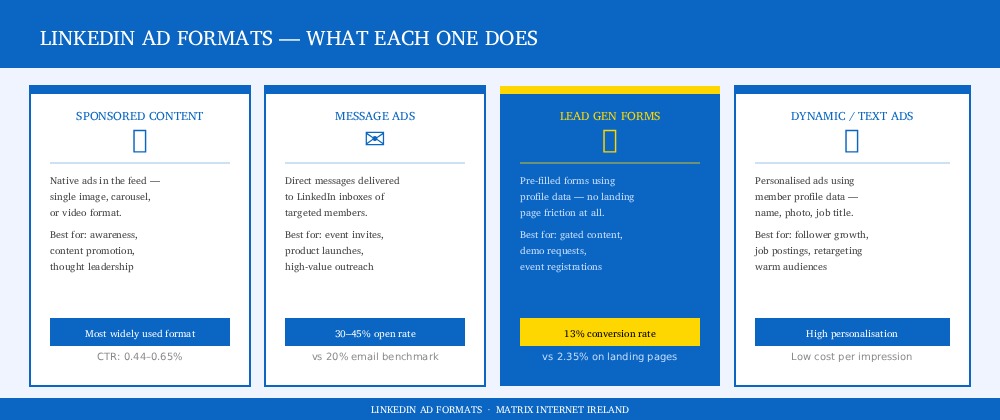
LinkedIn’s ad product range has expanded considerably. The choice of format matters significantly — different formats serve different stages of the funnel and different campaign objectives.
Sponsored Content is the most commonly used format — native ads that appear in members’ feeds as single images, carousels, or video. It is the workhorse of LinkedIn advertising, effective for brand awareness, content promotion, and thought leadership. Average click-through rates of 0.44 to 0.65% are lower than you might see on Meta, but the people clicking are doing so in a professional context with commercial relevance.
Lead Gen Forms are where LinkedIn’s most distinctive performance advantage sits. Rather than clicking through to a landing page, members can submit their information — pre-populated from their LinkedIn profile — without leaving the platform. The friction reduction is dramatic: Lead Gen Forms convert at 13%, compared to 2.35% for external landing pages — a 5x improvement that often offsets LinkedIn’s higher CPC and produces a lower cost per lead than the raw click cost implies. For gated content, demo requests, event registrations, or any campaign where lead volume matters, Lead Gen Forms change the economics of LinkedIn advertising materially.
Message Ads deliver personalised messages directly to LinkedIn inboxes of targeted members. They generate open rates of 30 to 45%, well above the 20% benchmark for email marketing — because a LinkedIn message from a brand feels more considered and relevant than an email, and the inbox context carries less noise. Message Ads work well for event invitations, product launches, and high-value outreach to specific audience segments.
Dynamic Ads use member profile data — including their name and profile photo — to create personalised ad experiences. They have lower CPMs than Sponsored Content and work particularly well for follower growth, job postings, and retargeting audiences who have already engaged with your brand.
Conversation Ads — an evolution of Message Ads that allows multiple CTA options within a single message — give prospects the ability to express their specific interest or objection, branching the conversation based on their response. For complex B2B offers with multiple audience segments or use cases, Conversation Ads allow a degree of personalisation that no other ad format provides.
LinkedIn vs Google vs Meta: The B2B Comparison
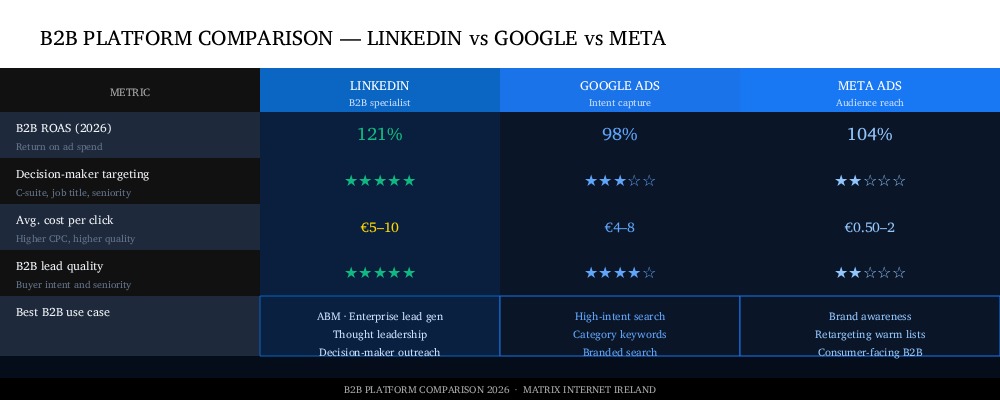
The honest comparison for B2B advertisers is not LinkedIn versus one alternative — it is LinkedIn in context with both Google Ads and Meta, understanding what each does better and where the budget should flow.
Google Ads captures demand that already exists. When a prospect searches “enterprise security software Ireland,” Google is where you need to be. It excels at high-intent keyword capture and is often the final step in a B2B purchase journey that LinkedIn or content marketing started. B2B ROAS on Google sits at 98% — strong, but behind LinkedIn. The platforms are complementary: LinkedIn builds the pipeline, Google captures it at the point of search.
Meta Ads offer dramatically lower CPCs and enormous audience reach, but the B2B targeting precision is fundamentally limited by the nature of Meta’s data. Interest-based and demographic targeting on Meta can approximate B2B audiences but cannot replicate the job title, seniority, company size, and industry precision that LinkedIn provides natively. Meta works for B2B brand awareness and retargeting warm audiences at scale, but struggles as the primary platform for decision-maker-level lead generation. B2B ROAS on Meta sits at 104% — above Google but below LinkedIn.
The full-funnel B2B paid strategy for businesses with sufficient budget is all three, with clear objectives for each: LinkedIn for decision-maker targeting, thought leadership, and Lead Gen Form capture; Google for search intent capture and branded search; Meta for broad awareness and retargeting. Businesses starting with limited budget should lead with LinkedIn if decision-maker access is the primary objective — the audience quality justifies the premium.
Account-Based Marketing: Where LinkedIn Has No Rival
Account-Based Marketing (ABM) — targeting specific named companies rather than broad audience segments — is one of the fastest-growing strategies in B2B marketing, and it is the area where LinkedIn’s advantage is most decisive. LinkedIn’s Matched Audiences feature allows advertisers to upload lists of target companies and target all LinkedIn members at those companies simultaneously — ensuring that a campaign reaches every relevant stakeholder across the buying committee at a target account, not just the one contact in a CRM.
For Irish businesses targeting specific enterprise accounts — whether domestically or across Europe — this capability has no equivalent on any other advertising platform. The combination of company targeting, job title filtering, and seniority targeting means you can reach the exact decision-making group at a named list of target companies with a consistency and precision that direct outreach cannot match at scale.
For Matrix Internet clients working in the enterprise B2B space, ABM on LinkedIn has become a significant part of paid digital marketing strategy — particularly for clients targeting the multinational sector in Ireland and EU institutional markets.
The Cost Objection — and Why It Misses the Point
The most common reason businesses avoid LinkedIn advertising is cost. At €5 to €10 per click, LinkedIn is significantly more expensive than Meta (€0.50–€2) and meaningfully more than Google Search (€4–€8) in comparable B2B categories. This comparison is real and worth understanding — but it is the wrong comparison to make in isolation.
The correct comparison is cost per qualified lead. A LinkedIn click from a VP of Operations at a 500-person company is worth more than ten Meta clicks from people whose job titles you cannot verify. When cost per qualified lead is measured — accounting for conversion rates, lead quality, and downstream close rates — LinkedIn frequently produces the lowest cost per qualified outcome despite the highest cost per click.
Lead Gen Forms make this particularly clear. At a 13% conversion rate versus 2.35% for a landing page, a campaign generating 1,000 clicks needs 77 clicks to produce one lead on LinkedIn versus 425 on a landing page. If those LinkedIn clicks cost €8 each and landing page clicks cost €1 each, the math is €616 per lead on LinkedIn versus €425 on the landing page — a 45% premium that may or may not be worth it depending on lead quality. If the LinkedIn leads are senior decision-makers who close at 3x the rate of the landing page leads, the cost per closed deal tells a completely different story.
This is why LinkedIn’s growing share of B2B budgets is driven by performance data rather than platform preference. Marketers who measure cost per qualified opportunity — not cost per click — consistently find LinkedIn’s economics more favourable than the raw CPC suggests.
What Good LinkedIn Advertising Actually Looks Like
The businesses that get the best results from LinkedIn advertising treat it as a long-game channel rather than a direct response platform. The B2B purchase cycle is measured in months, not days — which means the appropriate success metric for LinkedIn campaigns is not same-session conversion, but pipeline influence over a 60 to 90-day attribution window at minimum.
Consistent presence matters as much as individual campaign performance. A brand that appears in a decision-maker’s LinkedIn feed with useful, relevant content over several months — through a combination of organic posts and Sponsored Content — builds the familiarity and credibility that accelerates the sales conversation when the prospect is ready to engage. One-off LinkedIn campaigns without organic content backing them up consistently underperform sustained, integrated approaches.
Creative matters more on LinkedIn than most B2B marketers expect. LinkedIn’s own research shows that creative quality accounts for up to 75% of campaign performance variation — meaning the difference between a well-crafted ad and a generic one is larger than the difference between audience targeting strategies. B2B advertising that reads like a product brochure consistently underperforms content that addresses a real professional problem, offers a useful perspective, or demonstrates genuine expertise.
Audience targeting should start tightly and expand from evidence. Begin with a narrow, well-defined audience — specific job titles, seniority levels, company sizes, and industries — gather performance data, and expand to related audiences that show similar engagement patterns. LinkedIn’s audience sizes tend to be smaller than Meta, which makes precise targeting more critical and impression frequency management more important.
Summary
LinkedIn advertising is the dominant B2B paid media channel in 2026 not because of marketing fashion but because it solves a structural problem that no other platform can: concentrating decision-maker-level audiences at scale and at professional context. The data now confirms this structurally — 121% ROAS, 13% Lead Gen Form conversion rates, 80% of all B2B social media leads, and a growing share of B2B marketing budgets that reflects measured performance rather than platform preference.
The cost objection — LinkedIn is too expensive — persists among businesses that measure cost per click without measuring cost per qualified lead. The businesses that allocate budget based on cost per qualified opportunity consistently find that LinkedIn’s premium CPC is justified by the quality and close rates of the leads it generates. For decision-maker targeting, account-based marketing, and any B2B campaign where audience precision matters more than audience size, LinkedIn remains the most effective paid channel available.
If you want an honest assessment of whether LinkedIn advertising is right for your business, what budget is needed to see meaningful results, and how to structure campaigns that work alongside your existing Google and Meta activity, the paid digital marketing team at Matrix Internet works with B2B businesses across Ireland and Europe. Get in touch to discuss what a LinkedIn strategy would look like for your business.
At Matrix Internet, our paid digital marketing team helps B2B businesses get real returns from LinkedIn — building the audience targeting, creative and campaign structure that reaches decision-makers, and measuring performance on pipeline influence rather than clicks.
FAQs
For B2B businesses, usually yes — but the comparison needs to be made on cost per qualified lead rather than cost per click. LinkedIn's CPC typically runs €5 to €10, meaningfully higher than Meta at €0.50 to €2. However, LinkedIn Lead Gen Forms convert at 13% compared to 2.35% for external landing pages, which closes much of that gap. More importantly, the leads themselves are different: a click from a verified VP of Operations at a 500-person company has a different commercial value from a click from an unverified profile. When measured on cost per qualified opportunity and downstream close rates, LinkedIn consistently outperforms its CPC reputation. The businesses that find LinkedIn too expensive are usually measuring the wrong metric.
LinkedIn enforces a minimum daily budget of around €10 per campaign, but that figure is not a realistic starting point for meaningful results. For a B2B campaign targeting a defined audience in Ireland or a small European market, a practical minimum is €1,000 to €1,500 per month. Below this, you will struggle to generate enough impressions and clicks to gather statistically useful data, and campaign optimisation becomes guesswork. If your budget is under €1,000 per month, you will typically get better results by concentrating it on Google Search or by running a shorter, more intensive LinkedIn campaign over six to eight weeks rather than spreading a small budget thinly over a longer period.
Longer than most businesses expect, and the expectation needs to be set correctly at the outset. B2B purchase cycles now average 272 days from first marketing contact to closed revenue, involve around ten stakeholders, and require 88 touchpoints across multiple channels. Judging a LinkedIn campaign on 30-day conversion data will almost always produce a misleading picture. A realistic assessment window is 60 to 90 days minimum for lead generation campaigns, and six months for pipeline influence and revenue attribution. What you should see earlier — within two to four weeks — is engagement data: click-through rates, Lead Gen Form completion rates, and which audience segments and creative approaches are resonating. Use those early signals to optimise, and judge commercial outcomes on a longer horizon.
Account-Based Marketing on LinkedIn means targeting specific named companies rather than broad audience segments. Using LinkedIn's Matched Audiences feature, you upload a list of target companies and LinkedIn will serve your ads to members working at those organisations. Combined with job title and seniority filters, this allows you to reach the entire buying committee at a named target account — the CTO, the procurement lead, the finance director, and the end users — simultaneously and consistently. No other advertising platform offers equivalent precision for company-level targeting. For Irish businesses targeting the multinational sector, enterprise accounts, or specific EU institutional buyers, this capability is often the single strongest argument for using LinkedIn.
For most B2B businesses with sufficient budget, running both is the right approach — they do different jobs. Google Search captures demand that already exists: when a prospect searches for your category or a specific solution, Google is where you need to appear. LinkedIn builds and influences the pipeline before that search happens, reaching decision-makers in professional research mode months before they are ready to search. Given that 81% of the B2B buyer journey now occurs before any contact with sales, the LinkedIn contribution is often invisible in last-click attribution but material in actual pipeline creation. If budget forces a choice, lead with LinkedIn when decision-maker access and brand building are your priority, and lead with Google when you have an established category presence and high-intent search volume to capture.
By Matrix Internet


