


BLOG
Google or Meta Ads?
4 min read
Every Irish business owner running paid advertising has faced this question, usually when reviewing a budget that feels like it is not going far enough: should the money go on Google or on Facebook and Instagram? The answer that most agencies give — “it depends” — is correct but unhelpful. What it depends on is specific, knowable, and worth understanding clearly before you spend another euro on either platform.
This guide makes the comparison practical. Not a feature list, not a platform pitch — a straightforward framework for Irish businesses to decide where their paid budget does the most work, with the context to understand why.
The Fundamental Difference: Intent vs Interruption
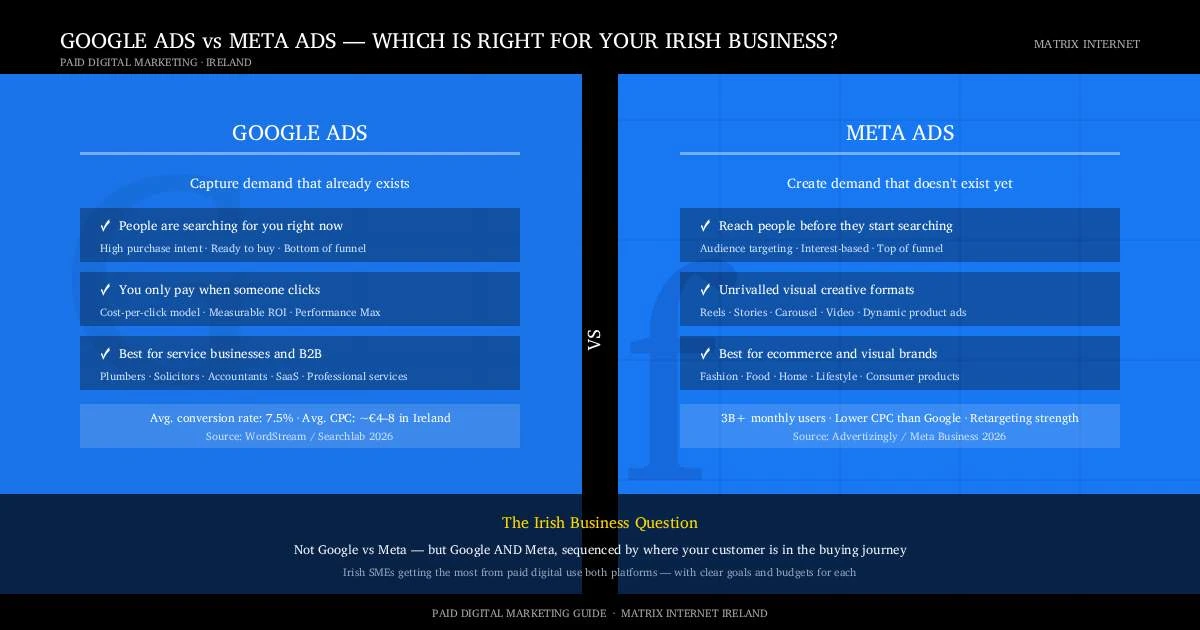
Everything about the Google Ads versus Meta Ads comparison flows from one distinction. Google Ads captures demand that already exists. Meta Ads creates demand that does not exist yet.
When someone types “emergency plumber Dublin” into Google, they have a problem right now and they are looking for the solution. When a Meta ad for a new homeware brand appears in someone’s Instagram feed, that person was not looking for anything — the ad interrupted what they were doing and introduced them to something they did not know they wanted. These are fundamentally different relationships between the advertiser and the customer, and they require fundamentally different approaches, objectives, and success metrics.
Neither approach is better than the other in absolute terms. The question is which one matches where your customer is in the buying journey — and which one matches where your business is in its growth stage.
How Google Ads Works and When It Excels
Google Ads operates primarily on a keyword auction model. You bid on the search terms your potential customers use, and your ads appear when those terms are searched. You pay when someone clicks. The result is direct, measurable, and tied to active buyer intent — the people clicking your ad have self-selected as interested in what you offer by virtue of their search query.
The platform has evolved significantly. Performance Max campaigns — Google’s AI-driven campaign type that distributes your ads across Search, YouTube, Gmail, Maps, and Display simultaneously — are now used by 72% of advertisers, a figure that reflects how central automation has become to how Google Ads works. You set the objective, provide creative assets and budget, and Google’s machine learning determines where and when to show your ads for the best results.
The conversion numbers are strong. Google Ads’ average conversion rate has increased to 7.52% in 2025 — a figure that reflects both the quality of search intent and the maturity of the platform’s targeting. For context: that means roughly one in thirteen clicks turns into a measurable action. For high-value service businesses, that ratio justifies the cost per click even when CPCs are significant.
When Google Ads is the right choice for Irish businesses
Local service businesses. If a potential customer searches “solicitor Dublin 4,” “accountant Cork,” or “web design agency Ireland,” and your business does not appear, you have already lost that customer to whoever does. Google Search is the natural home for any service business that depends on capturing local demand. The combination of Google Search campaigns and Google Business Profile for local visibility is the highest-priority paid investment for most Irish service businesses.
B2B and professional services. Business buyers research before they buy, and that research happens predominantly through search. Decision-makers searching for software, consultancy services, managed IT, or professional services are demonstrating commercial intent when they search — and Google is where that intent is expressed. B2B and high-ticket services perform better on Google Ads because decision cycles are longer, intent is research-driven, and Google Search captures decision-makers actively looking for solutions.
High-urgency purchase categories. Emergency services, same-day delivery, time-sensitive professional needs — anything where the customer needs a solution immediately is a Google Ads category. The immediacy of search intent makes Google the dominant channel for urgency-driven purchasing.
When budget is limited and accountability matters. Google Search’s pay-per-click model means you only pay for demonstrated interest. For businesses with tight budgets and a need to justify every euro spent, the accountability of search advertising is a significant advantage. You know exactly how many clicks you received, what they cost, and what percentage converted.
How Meta Ads Works and When It Excels
Meta Ads — covering Facebook, Instagram, Messenger, and the Audience Network — operates on an entirely different logic. Rather than targeting what people are searching for, it targets who people are: their demographics, interests, behaviours, location, life events, and relationship to your brand. You pay to appear in their feed whether or not they were looking for you.
This interruption model sounds less efficient than search — and for bottom-of-funnel conversion, it generally is. But it solves a problem that Google Ads cannot: it puts your brand in front of people who have never heard of you and would never search for you, because they do not yet know they want what you offer. Meta Ads win on demand creation, visual creative, and audience-based targeting.
The platform’s scale is staggering. With over three billion monthly active users across Facebook and Instagram, Meta’s reach covers the overwhelming majority of the Irish online population. Ireland has some of the highest social media usage rates in the EU, with Facebook and Instagram penetration particularly strong across the 25–55 age bracket that represents the purchasing demographic for most consumer businesses.
When Meta Ads is the right choice for Irish businesses
Ecommerce with visual products. If your product looks good, Meta is where it performs. Fashion, homeware, food, beauty, gifts, lifestyle products — these categories convert from visual ads because the ad itself is the product demonstration. Consumer brands with strong visual identity and impulse-buy products consistently achieve higher ROAS on Meta. Dynamic product ads — which automatically show each user the specific products from your catalogue they are most likely to buy based on their browsing behaviour — are among the most powerful ecommerce tools available on any platform.
Brand-new businesses or products with no existing search demand. If you are launching something that people do not yet know to search for, Google Ads will not help you — there are no searches to capture. Meta is where you introduce your brand, create awareness, and build the audience that will eventually convert. This is the demand creation role that Meta is uniquely equipped to fill.
Retargeting warm audiences. One of Meta’s most powerful capabilities is retargeting — showing ads specifically to people who have visited your website, added something to their cart, engaged with your content, or interacted with your brand previously. Retargeting site visitors with the exact product they viewed drives 3–5x higher conversion than cold prospecting. For ecommerce businesses in particular, a well-configured Meta retargeting campaign is often the single highest-ROAS activity in the entire paid marketing mix.
Businesses targeting specific demographics or life events. Meta’s audience targeting depth has no equivalent. If your business serves first-time homeowners, new parents, people who have recently moved to Ireland, or any other demographic defined by life stage or interest, Meta can reach them with a precision that search targeting cannot match.
The Numbers: What the Benchmarks Actually Say
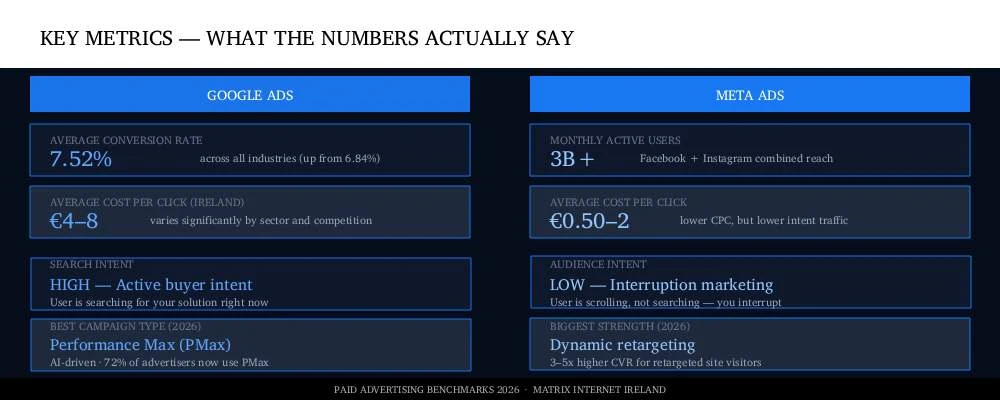
Comparing Google and Meta on cost-per-click is a common but misleading exercise. Google Ads now costs an average of €5.26 per click globally, with Irish CPCs typically in the €4–8 range for competitive service categories. Meta’s cost per click is substantially lower — often €0.50 to €2 for Irish audiences — but the comparison is only meaningful if you also compare the quality of the traffic those clicks represent.
A €1 click from someone scrolling Instagram who was not looking for your product is not necessarily better value than a €6 click from someone who just searched for exactly what you sell. The right metric to compare is cost per acquisition — how much you spend across all channels to bring in one customer. That figure varies enormously by business type, sector, and how well campaigns are structured and managed.
The conversion rate difference is significant. Google Search’s 7.52% average conversion rate versus Meta’s typically lower rates reflects the intent gap — search traffic converts better because the person was already in buying mode. But Meta’s retargeting conversion rates, applied to warm audiences who have already interacted with your brand, can approach and in some cases exceed search rates for the right product categories.
Which Platform Suits Which Irish Business?
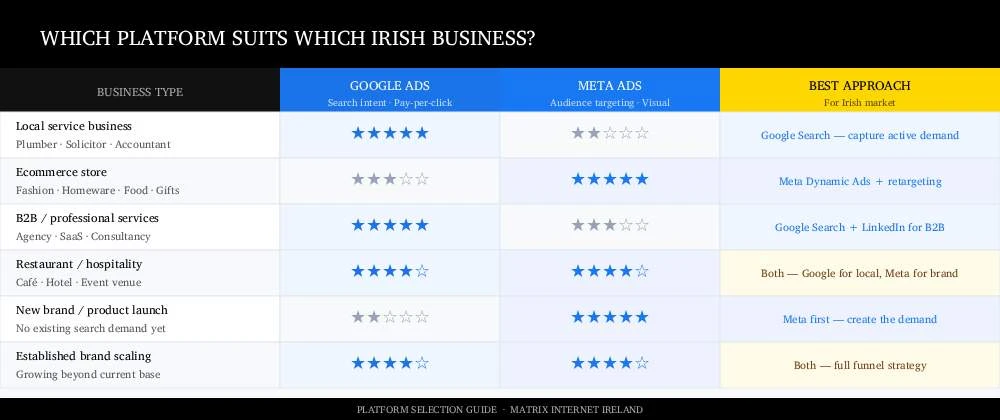
The framework is straightforward once you know the principle: match the platform to where your customer is in their buying journey, and match your budget to where the most measurable value is for your specific business type.
Local service businesses — plumbers, solicitors, accountants, dentists, mechanics, cleaners — should start with Google Search. Your customers have an active need and are searching for someone to meet it. Be the answer. Meta can supplement with brand awareness for these businesses, but it is not where the high-intent traffic lives.
Ecommerce businesses selling visual products should start with Meta — particularly Meta’s Dynamic Ads connected to their product catalogue, and retargeting campaigns for site visitors. Google Shopping and Performance Max campaigns add significant value once the Meta foundation is in place and budget allows both.
B2B and professional services businesses should lead with Google Search, supplemented potentially by LinkedIn Ads for precise professional targeting. Meta can work for B2B brand awareness but the conversion path is longer and harder to track.
New brands launching without existing search demand should start with Meta. You cannot capture demand that does not exist. Use Meta to build awareness and create the audience that will eventually search for you — then capture those searches with Google once the brand has traction.
Established businesses with both an existing customer base and growth ambitions almost always benefit from running both platforms with a clear objective for each: Google captures active demand, Meta expands reach and retargets.
The Case for Using Both — The Full-Funnel Approach
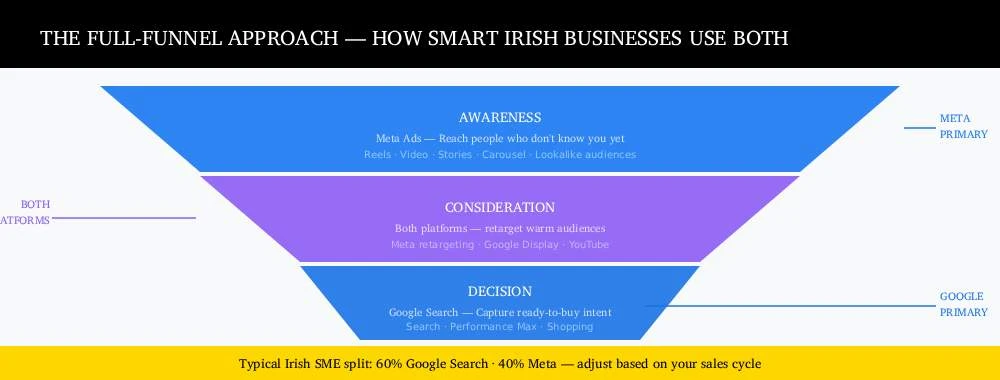
The most effective paid digital strategies for Irish businesses are not Google or Meta — they are Google and Meta, with a clear allocation of roles. The full-funnel approach assigns each platform to the stage of the customer journey where it naturally excels, then uses both together to move customers from first awareness to final purchase.
At the top of the funnel, Meta creates awareness. A potential customer sees a video ad for your brand while scrolling Instagram — they do not click, but they see the name and the product. A week later, they see a retargeting ad featuring the specific product they glanced at. Their interest is piqued. They Google the brand name — and your Google Search brand campaign, or your organic ranking, captures that intent. They visit the site, do not buy. Meta retargeting follows them with a limited-time offer. They convert.
This multi-touch journey is how a significant proportion of considered purchases actually happen. Attributing the sale to either Google or Meta alone misses the contribution of both. Businesses that run only one platform are missing the touchpoints that the other provides, and their conversion rates typically reflect that gap.
For Irish SMEs managing limited budgets, the practical sequencing is: start with the platform that addresses your most immediate revenue need (usually Google Search for service businesses, Meta for ecommerce), prove the return, then allocate a portion of that return to the second platform. A typical starting split for businesses ready to run both is 60% Google, 40% Meta — adjusted based on your sales cycle length and product type.
Common Mistakes Irish Businesses Make on Both Platforms
On Google Ads: targeting keywords that are too broad, which burns budget on irrelevant traffic. A solicitor bidding on “legal advice” will pay for clicks from people looking for free information, student resources, or services in different jurisdictions. Tight keyword targeting and a robust negative keyword list are the difference between a Google Ads campaign that delivers leads and one that drains budget.
On Meta Ads: running ad creative that looks like an ad. Meta’s algorithm favours native-feeling content — ads that blend into the feed rather than announcing themselves as advertisements. Polished brand imagery from a photo shoot often performs worse than authentic video content that looks like it was created by a real person for real people. Irish businesses that lean into this tend to see significantly better Meta performance than those who repurpose their print or broadcast creative without adaptation.
On both: not having the Meta Pixel and Google conversion tracking properly configured before spending a euro. Without accurate conversion tracking, you cannot measure which campaigns, ad sets, or keywords are actually generating sales or leads — and you are flying blind. This is the most common and most costly mistake, and it is entirely preventable.
Budget: What Does It Cost to Run Both in Ireland?
There is no universal right answer, but there are useful starting points. For Google Search campaigns targeting Irish traffic in a competitive category — legal services, financial services, home services — a minimum effective budget is typically €500–€1,000 per month to generate enough data to optimise. Thinner budgets can work in less competitive niches, but in competitive Irish markets a significant minimum is required to generate enough impression share to be visible.
Meta Ads can be started for less — meaningful testing is possible from €300–€500 per month, though higher budgets allow faster learning. The advantage of Meta’s lower CPCs is that you can reach a meaningful number of people at modest budget levels; the challenge is that the lower intent means you need more impressions to generate the same conversion volume.
For businesses new to paid advertising, starting with one platform and mastering it before expanding to the second is almost always better than splitting a limited budget across both prematurely. Do not run two mediocre campaigns when one well-managed campaign will teach you more and deliver better returns.
Summary
Google Ads captures existing demand — people searching for what you offer right now. Meta Ads creates demand — reaching people who do not yet know they want what you offer. Service businesses and B2B should typically lead with Google; ecommerce and visual consumer brands should lead with Meta. New brands with no existing search demand must start with Meta. Established businesses with growth ambitions should use both, with a clear objective for each.
The businesses getting the best return from paid advertising in Ireland are not the ones spending the most — they are the ones who have matched their platform to their customer’s buying journey, structured their campaigns correctly, and built the measurement foundation that allows continuous optimisation. The platform choice matters, but it matters less than the quality of execution on whichever platform you choose.
If you want an honest assessment of where your paid budget would do the most work — or if you are running Google or Meta campaigns that are not delivering the returns they should — the paid digital marketing team at Matrix Internet works with Irish businesses across both platforms. We are happy to audit what you have in place and tell you plainly what we would do differently. Get in touch to start the conversation.
By Panos


