


BLOG
Stock Photos and AI Images: The Trust Cost and the Licensing Traps
4 min read
Matrix is proud to join PACE, now launched in Moldova. The Erasmus+ project strengthens youth organisations across the region with training, digital resources and collaboration to support displaced Ukrainian young people.
Every website needs pictures, and almost nobody has enough of them. So the gap gets filled the easy way: a stock library, or lately an AI generator. Both are fast, both look professional at a glance, and both cost far less than a photographer.
The trouble shows up later. Visitors quietly discount images they recognise as filler, which undermines the exact page you were trying to strengthen. And a surprising number of images come with conditions nobody read, some of which only matter once the site is live and the business is using the picture in a way the licence never covered.
This guide covers both halves of the problem: why generic visuals weaken trust, where the licensing traps are, and what to use instead. It is written for site owners and anyone commissioning web design work.
Why Generic Images Weaken a Page
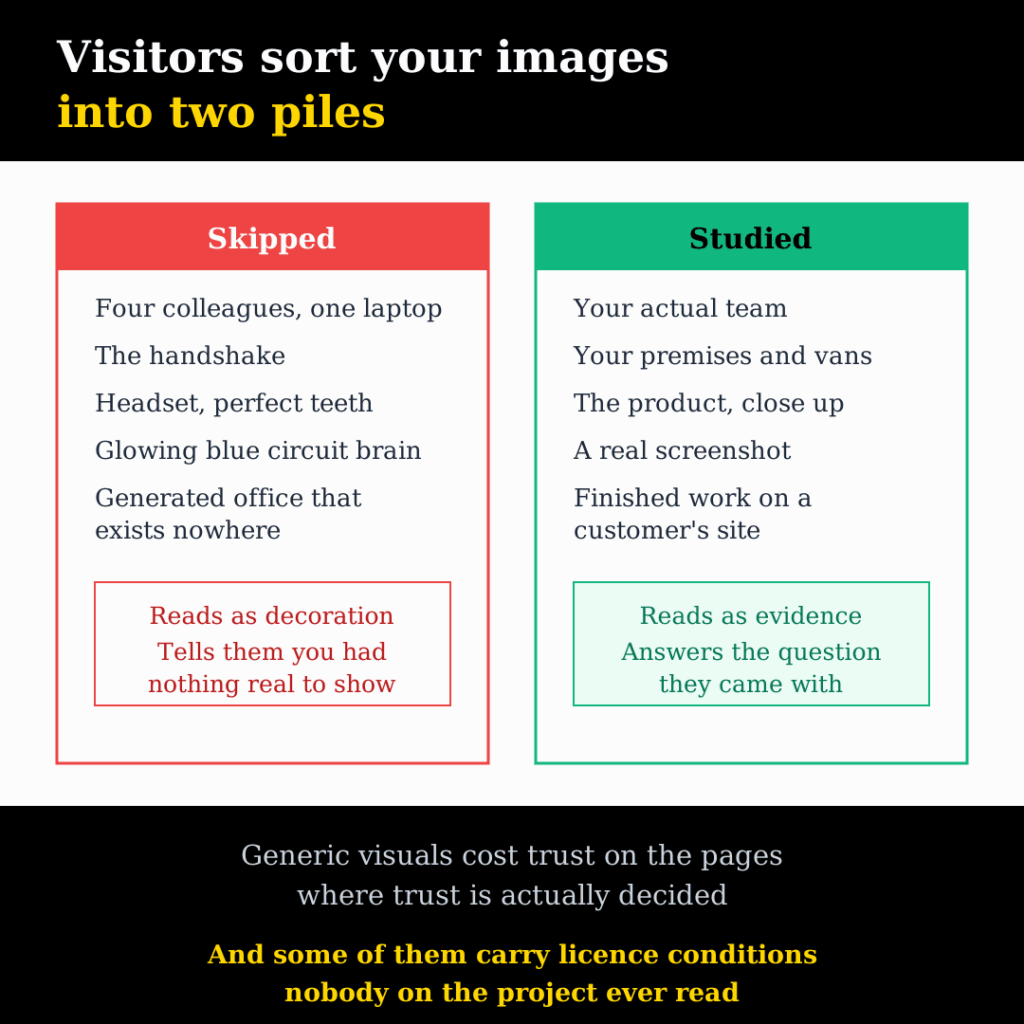
People do not look at every image on a page. They sort them, fast, into “this tells me something” and “this is decoration”, and they skip the second kind entirely.
Nielsen Norman Group’s eyetracking work on photos as web content found exactly this split. Images that exist to jazz up a page get ignored. Photos of real staff and real products get studied closely, because visitors are using them to answer a question: who are these people, and is this thing what I think it is?
A stock photo of four colleagues laughing at a laptop answers neither question. Worse, it answers a different one. It tells an experienced visitor that this page was assembled quickly and that the company either had nothing real to show or did not think it was worth showing. That is not the impression you paid for.
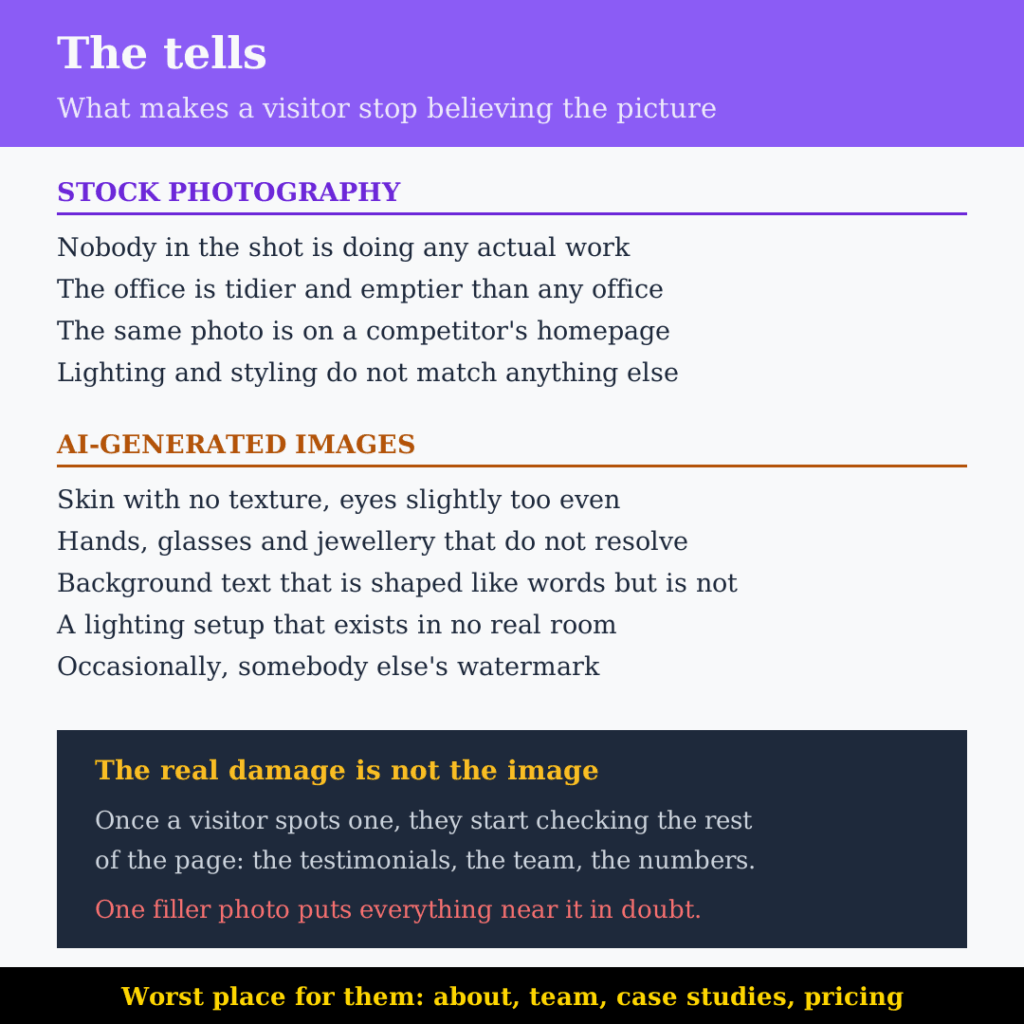
AI images have the same problem with an extra edge on it. The tells are getting subtler, but people have become very good at spotting them: skin with no texture, hands that do not quite work, text in the background that is not words, a lighting setup that exists nowhere. The moment a visitor notices, two things happen at once. They stop trusting the picture, and they start wondering what else on the page was generated.
This matters most in the places where trust is actually being decided: the about page, the team page, case studies, testimonials, and anything near a price or a contact form.
The Licensing Traps
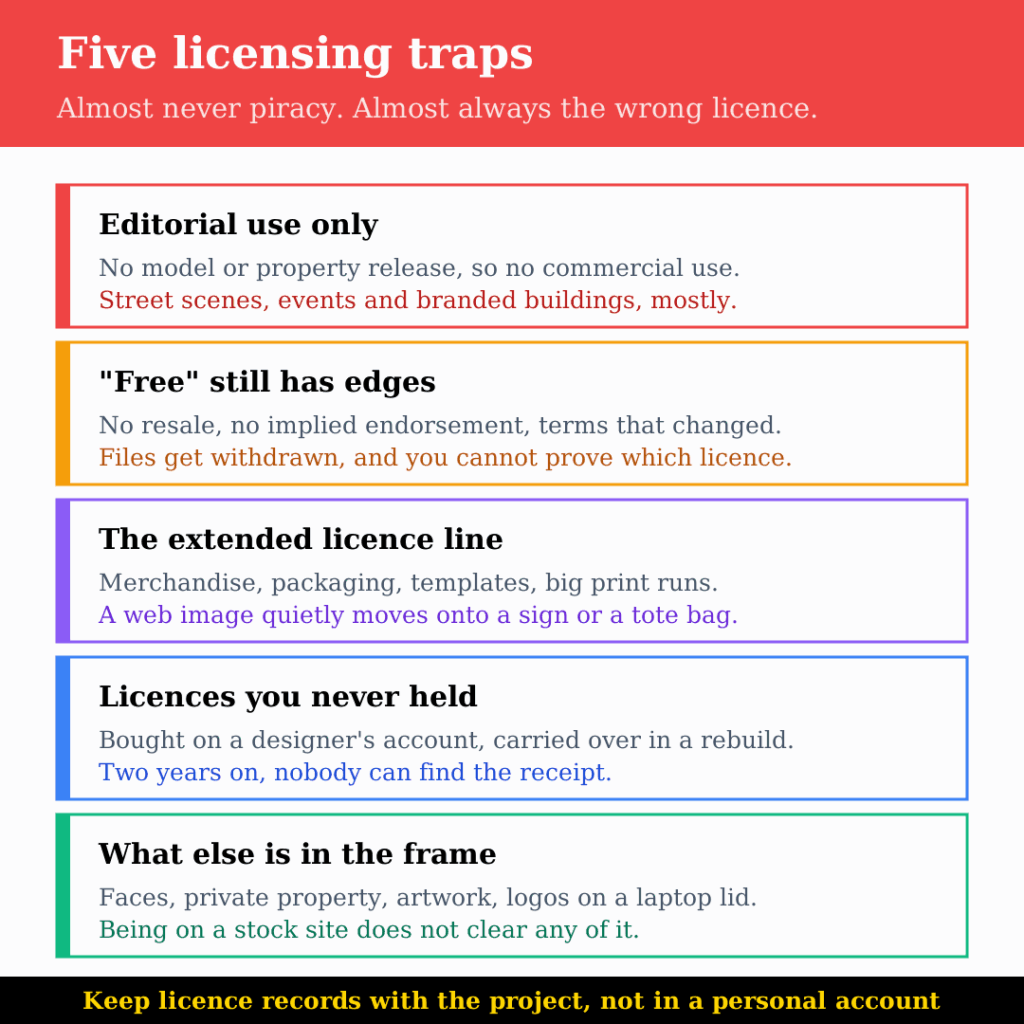
Most stock licensing problems are not piracy. They are ordinary businesses using an image in a way the licence they bought does not cover, usually without realising there was a distinction.
Editorial Use Only
This is the most common one. Editorial images are intended for news and commentary, and they do not carry model or property releases. That means they cannot be used commercially, promotionally, or in anything that implies endorsement. A photo from a trade show, a city street scene with recognisable faces, a shot of a branded building: these are frequently editorial, and they are frequently found on company homepages where they do not belong.
“Free” Does Not Mean Unrestricted
Free libraries are genuinely useful, but their licences still have edges. Typical conditions include no reselling the image unaltered, no using it to build a competing stock service, and no implying that a person pictured endorses your product. Some free sites changed their terms over the years, and images get removed when a contributor withdraws them or a rights dispute arises. A licence you relied on in 2022 is not automatically the licence that applies to that file now, and you often cannot prove which version you accepted.
The Extended Licence Threshold
Standard licences cover website and marketing use up to a point. Cross that point and you need an extended licence: merchandise, packaging, anything resold as a template or product, and large print runs. Businesses hit this without noticing when a web image migrates onto a tote bag, a sign, or a brochure printed in volume.
Images You Never Actually Licensed
This one catches agencies and clients equally. A designer buys an image under their own subscription, the project ends, and the licence goes with them. Or a site gets rebuilt and the old imagery is carried across without anyone checking what it was. Or a contractor used a search engine. Years later a rights-enforcement letter arrives, and nobody can find a receipt. Keep the licence documentation with the project files, not in somebody’s personal account.
What Else Is in the Frame
Recognisable people need a model release. Recognisable private property, some buildings, and artwork on a wall may need a property release. Logos and branded products in the background carry their own trademark issues. The image being on a legitimate stock site does not clear any of this by itself.
Where AI Images Currently Stand
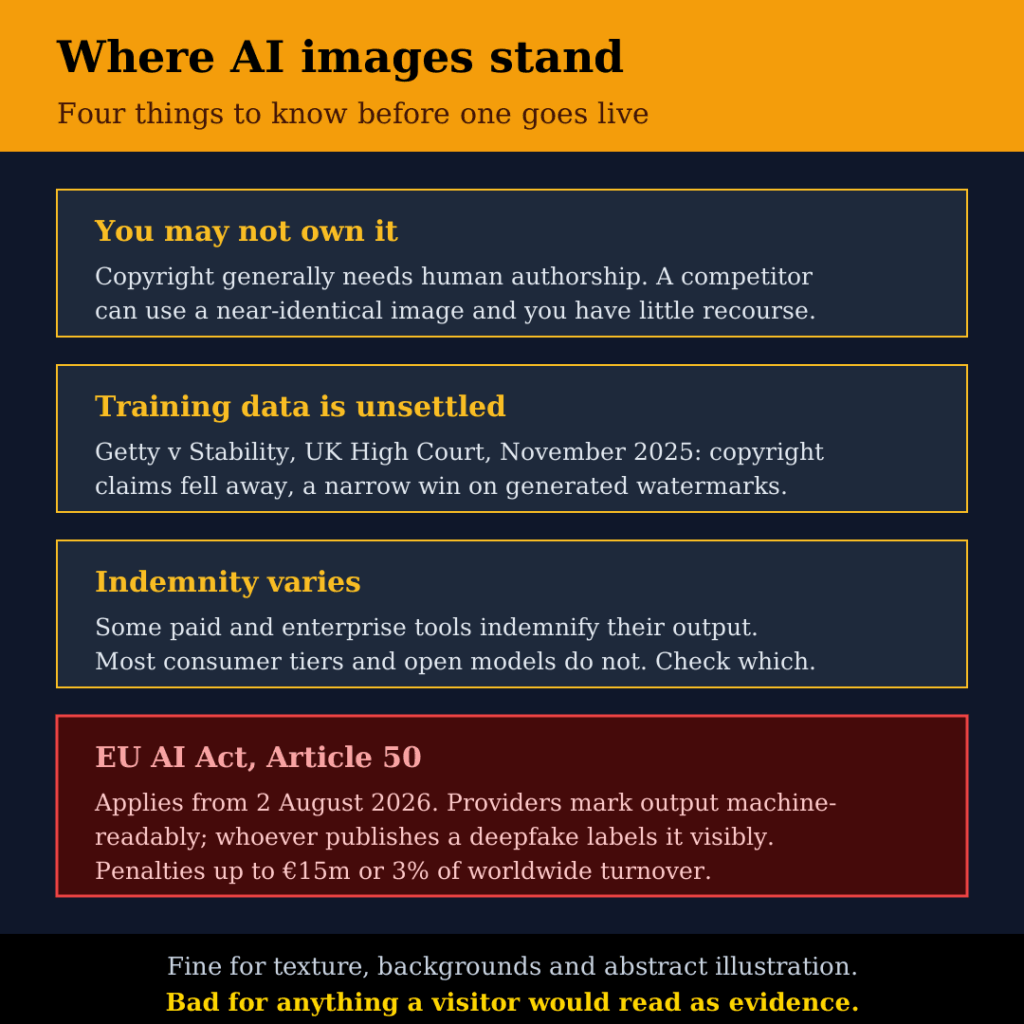
This area is moving, and anything written about it has a shelf life. As things stand, four points matter for an ordinary business website.
You may not own what you generated. Copyright protection generally requires human authorship. The US Copyright Office’s 2025 report on copyrightability concluded that material generated purely from a prompt is not protectable, while work where a human contributed genuine creative expression can be. The practical consequence is simple: a competitor can use a near-identical generated image and you may have nothing to stop them with.
The training-data question is not settled. In Getty Images v Stability AI, the UK High Court gave judgment in November 2025. Getty’s copyright claims fell away, and most of its trade mark claims failed. It won narrowly, on specific examples where generated images carried an iStock or Getty Images watermark. The decision is persuasive rather than binding in Ireland, and it may be appealed, but the watermark point is the one that should interest site owners: generators can reproduce recognisable marks, and that risk sits with whoever publishes the image.
Indemnity varies enormously. Some enterprise and paid generators offer legal indemnity for outputs. Most consumer tiers and open models offer none. If an AI image is going on a commercial website, check which of those you are using before it goes live rather than afterwards.
The EU AI Act’s transparency rules apply from 2 August 2026. Article 50 requires AI-generated content to be marked in machine-readable form by providers, and requires deployers to label deepfakes in a way people can actually perceive, with a narrower exemption for obviously artistic or creative work. The Commission’s guidelines on these obligations are worth reading if you publish AI imagery of people, places or events that could be taken for real. Penalties run to €15 million or 3% of worldwide turnover.
What to Use Instead
The alternative is not an expensive campaign shoot. It is usually one planned half-day.
- Photograph the real thing. Your team, your premises, your product, your process, your vans, your workshop. Ordinary photography of real things beats polished photography of nothing, and it is the one kind of image a competitor cannot copy.
- Use screenshots and real interface. If you sell software or run a service with a portal, show it. Visitors looking at a price want to see what they get.
- Commission diagrams and illustrations. For abstract subjects — a process, a comparison, a structure — a diagram made for your content carries more information than any photograph, and it fits your brand design rather than fighting it.
- Ask customers. A photo of your work on a real customer’s site, with written permission, does more for a case study than anything a library can sell you. If people are identifiable, get consent in writing and handle it in line with your data protection obligations.
- If you do use stock, use it deliberately. Pick specific over generic, avoid the images everyone else has, apply the same crop and treatment across the site so they read as one set, and keep them away from the pages where trust is being decided.
The same applies to AI images. They are reasonable for backgrounds, textures, abstract illustration and internal drafts. They are a bad choice for anything a visitor might read as evidence: your team, your premises, your customers, your results.
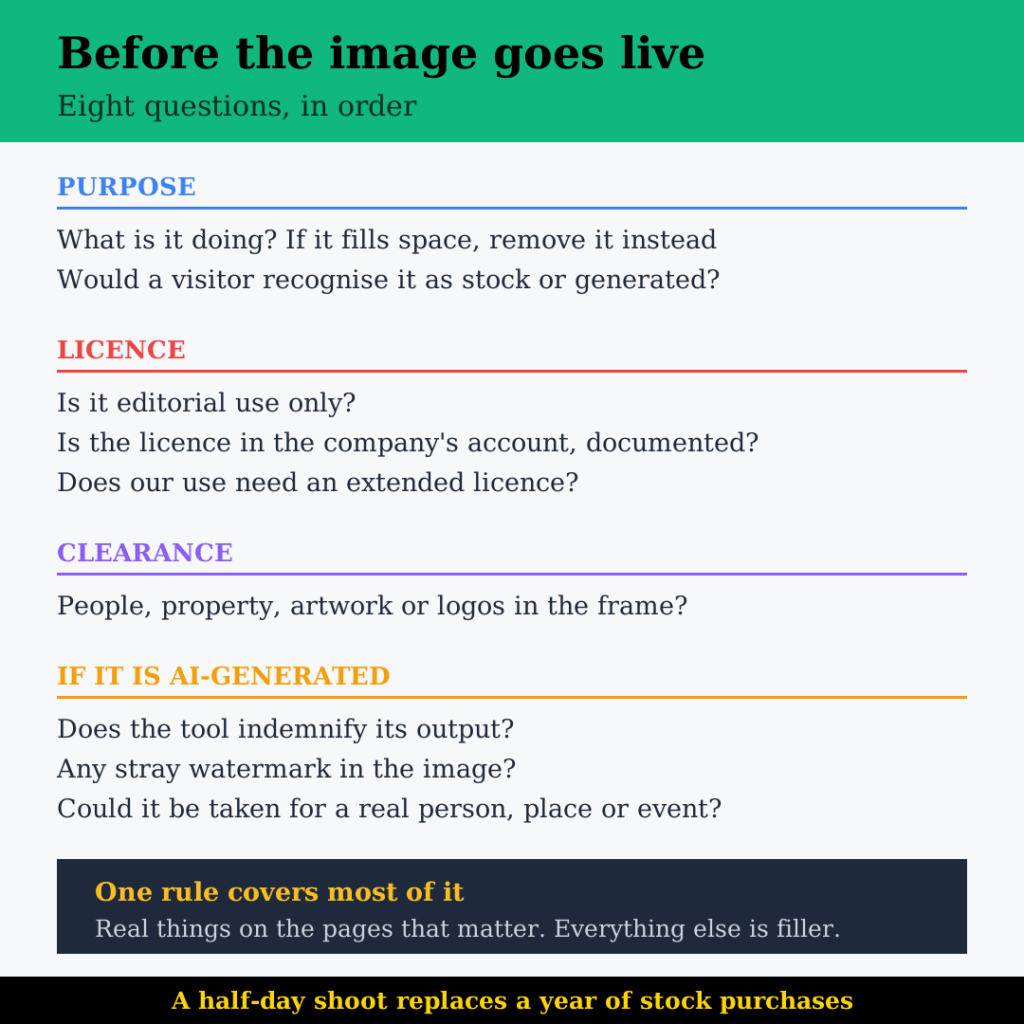
A Short Check Before an Image Goes Live
- What is this image doing? If the answer is “filling space”, remove it instead.
- Would a visitor recognise it as stock or AI? If yes, it is working against the page.
- Is it editorial-use-only? If so, it cannot go on a commercial page.
- Do we hold the licence, in the company’s account, with documentation saved?
- Does the intended use exceed the standard licence — merchandise, packaging, large print runs, resale?
- Are identifiable people, private property, artwork or logos in the frame, and are they cleared?
- If it is AI-generated, does the tool provide indemnity, and does anything in the output look like someone else’s watermark?
- If it shows people, places or events that could be taken for real, does it need to be labelled?
What to Ask Your Web Design Agency
Imagery is usually agreed late in a project, when the budget is tight and the deadline is close, which is exactly why these questions are worth asking early:
- Who will hold the licences for images on our site, us or you?
- Will we receive the licence documentation and the original files?
- What happens to those licences if we move to another agency or rebuild the site?
- Are any images on the proposed design AI-generated, and which tool produced them?
- Is a photography session in scope, and what would a half-day cost?
- Who is responsible if a rights claim arrives two years after launch?
Clear answers to those six are a reasonable test of how a website build is being run generally. “We’ll sort out the images later” is how most of the problems in this article start.
None of this makes stock photography or AI generation off-limits. It makes them tools with conditions attached, to be used where they fit and kept away from the pages where a visitor is deciding whether to believe you.
If your site is still running on stock photography, we can tell you which pages it is costing you and what a half-day of real photography would replace — get in touch.
FAQs
Yes, used deliberately. Stock works for backgrounds, textures, abstract concepts and supporting images well down a page, and it works best when you pick specific images rather than the obvious ones and apply the same crop and treatment across the site so they read as a set rather than a collection. Where it fails is on the pages where someone is deciding whether to trust you: the about page, the team page, case studies, testimonials and anything beside a price or a contact form. Those pages need real things in them.
For some things, yes. Abstract illustration, background texture, diagrams and internal drafts are all reasonable uses. The problem is photorealistic images of people, premises or results, because a visitor reads those as evidence and will discount the whole page if they spot a tell. There are also practical checks worth doing first: whether your tool offers legal indemnity for its output, whether anything in the image looks like a stray watermark, and whether the image is realistic enough that transparency rules would apply to it.
It means the image can be used in news and commentary but not to promote anything. Editorial images do not come with model or property releases, so the people and places in them have not agreed to appear in advertising. A photo from an event, a street scene with recognisable faces, or a shot of a branded building is often editorial. Putting one on a homepage, a services page or in an ad is a breach of the licence even though you paid for the image, and it is one of the most common mistakes on business websites.
Generally yes, but they are not condition-free. Typical terms stop you reselling images unaltered, using them to build a competing service, or implying that someone pictured endorses your product, and none of them clear trademarks or the rights of identifiable people. The bigger practical risk is record-keeping. Free sites have changed their terms over the years and images get withdrawn, so a licence you relied on several years ago may not be the one that applies to that file now, and you usually cannot prove which version you accepted.
Whoever bought them, which is often not the business that owns the site. If a designer licensed images through their own subscription, the rights usually sit with them and may not transfer when the project ends or when you move to another agency. Ask the question before the project starts, get the licences held in your company's account where possible, and keep the documentation with the project files rather than in an individual's inbox. It is a five-minute conversation that saves a difficult one years later.
By Matrix Internet


