
BLOG
The Complete Guide to Large Language Models
Past, Present, and Future Introduction Large Language Models (LLMs) have emerged as one of the most transformative technologies of the 21st century, fundamentally changing how we interact with computers and process information. These sophisticated AI systems can understand, generate, and manipulate human language with remarkable proficiency, opening new possibilities across virtually every industry and domain […]
Past, Present, and Future
Introduction
Large Language Models (LLMs) have emerged as one of the most transformative technologies of the 21st century, fundamentally changing how we interact with computers and process information. These sophisticated AI systems can understand, generate, and manipulate human language with remarkable proficiency, opening new possibilities across virtually every industry and domain of human activity.
What Are Large Language Models?
Large Language Models are artificial intelligence systems trained on vast amounts of text data to understand and generate human language. At their core, LLMs are neural networks with billions or even trillions of parameters that learn statistical patterns in language. These models can perform a wide range of tasks, from answering questions and writing essays to translating languages and generating code.
The “large” in Large Language Models refers to both the size of the training dataset and the number of parameters in the model. Modern LLMs are trained on hundreds of billions to trillions of words from books, websites, articles, and other text sources, allowing them to develop a nuanced understanding of language, context, and even reasoning patterns.
Unlike earlier AI systems that were designed for specific tasks, LLMs are remarkably versatile. They can adapt to new tasks with minimal additional training through techniques like few-shot learning, where the model learns from just a few examples provided in the prompt. This flexibility has made them invaluable tools for businesses, researchers, educators, and individuals alike.
The History of Large Language Models
The journey to modern LLMs spans several decades of AI research, building on foundations in linguistics, cognitive science, and computer science.
Early Foundations (1950s-1990s)
The conceptual groundwork for language models began in the 1950s with early natural language processing research. Early systems like ELIZA (1966) could simulate conversation through pattern matching, but lacked true understanding. Statistical language models emerged in the 1980s and 1990s, using probability to predict word sequences, primarily for applications like speech recognition and machine translation.
The Neural Network Revolution (2000s-2010s)
The 2000s saw the rise of neural network approaches to language processing. Recurrent Neural Networks (RNNs) and Long Short-Term Memory (LSTM) networks could process sequential data more effectively, but still struggled with long-range dependencies in text. The breakthrough came in 2017 with the introduction of the Transformer architecture by Vaswani et al. in the paper “Attention Is All You Need.” This architecture used self-attention mechanisms to process entire sequences simultaneously, dramatically improving performance and enabling the training of much larger models.
The Modern Era (2018-Present)
The release of BERT by Google in 2018 demonstrated the power of pre-training large models on massive datasets and then fine-tuning them for specific tasks. OpenAI’s GPT series, beginning with GPT-1 in 2018, showed that language models could be scaled up dramatically with impressive results. GPT-2 (2019) generated coherent long-form text, while GPT-3 (2020) with 175 billion parameters demonstrated remarkable few-shot learning capabilities.
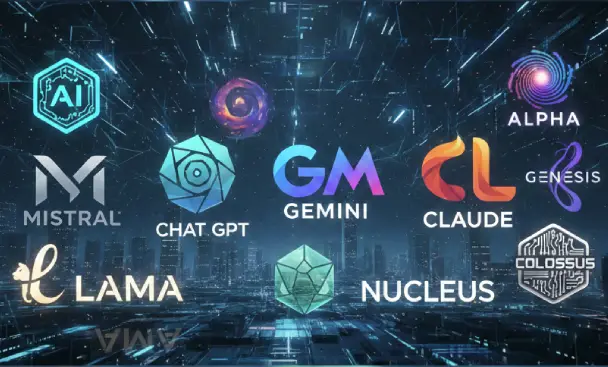
The launch of ChatGPT in November 2022 marked a watershed moment, bringing LLMs into mainstream consciousness. The public’s enthusiastic adoption demonstrated the technology’s accessibility and utility. This was followed by rapid developments, including GPT-4, Claude, Google’s Gemini, and numerous open-source alternatives like LLaMA and Mistral, each pushing the boundaries of what LLMs could achieve.
By 2024 and into 2025, LLMs had become increasingly sophisticated, with improved reasoning abilities, multimodal capabilities (processing text, images, and other data types), and more efficient architectures. The field continues to evolve at a breathtaking pace.
Which LLM Is Best for What?
Different LLMs excel at different tasks, and the “best” choice depends on your specific needs, constraints, and priorities. Here’s a breakdown of leading models and their strengths:
GPT-4 and GPT-4 Turbo (OpenAI)
Best for: Complex reasoning, creative writing, detailed analysis, multimodal tasks
GPT-4 remains one of the most capable models available, excelling at tasks requiring deep reasoning, nuanced understanding, and creative problem-solving. It performs exceptionally well on academic benchmarks and professional exams. The Turbo variants offer faster responses and lower costs while maintaining strong performance. GPT-4 is particularly strong at following complex instructions, maintaining context over long conversations, and handling sophisticated analytical tasks.
Ideal use cases: Research assistance, content creation, complex problem-solving, tutoring, detailed data analysis
Claude (Anthropic)
Best for: Long-context understanding, thoughtful analysis, ethical reasoning, writing assistance
Claude models, including the current Claude Sonnet 4.5, are known for their ability to process very long documents (up to hundreds of thousands of tokens), making them excellent for analysing lengthy texts, codebases, or transcripts. Claude tends to provide thoughtful, nuanced responses and is particularly strong at maintaining consistency and accuracy over extended interactions. The model family offers different sizes optimised for various needs, from the powerful Opus to the efficient Haiku.
Ideal use cases: Document analysis, legal research, coding assistance, creative writing, summarisation of long texts
Gemini (Google)
Best for: Integration with Google services, real-time information, multimodal tasks
Google’s Gemini models integrate seamlessly with Google’s ecosystem and can access current information through search. Gemini Pro and Ultra variants offer strong performance across various tasks, with particular strengths in mathematical reasoning and code generation. The models’ multimodal capabilities allow them to process and understand images, audio, and video alongside text.
Ideal use cases: Research requiring current information, tasks involving Google Workspace, multimodal applications, and coding
Open-Source Models (LLaMA, Mistral, others)
Best for: Privacy, customisation, cost control, specialised applications
Open-source models like Meta’s LLaMA series, Mistral, and others offer significant advantages for organisations with specific requirements. They can be run locally or on private infrastructure, ensuring data privacy and security. These models can be fine-tuned for specialised tasks or domains, and their open nature allows for transparency and customisation. While they may not match the largest proprietary models in general capabilities, they’re often sufficient for specific use cases and offer complete control.
Ideal use cases: Enterprise applications with privacy requirements, specialised domain applications, research, cost-sensitive deployments
Specialized Models
Various companies have developed LLMs optimised for specific domains. For example, Bloomberg has GPT for finance; there are models specialised for legal analysis, medical applications, and scientific research. These models are trained or fine-tuned on domain-specific data and often outperform general models in their specialised areas.
Ideal use cases: Industry-specific applications where domain expertise is critical
Selection Criteria
When choosing an LLM, consider these factors:
Performance requirements: How complex are your tasks? Do you need cutting-edge capabilities or will a smaller, faster model suffice?
Cost: API costs vary significantly between models and providers. Larger models are more expensive per token but may require fewer interactions to achieve results.
Privacy and security: Do you need to keep data on-premises or within specific regulatory boundaries?
Integration needs: Which model integrates best with your existing tools and workflows?
Latency requirements: How quickly do you need responses? Smaller models generally respond faster.
Context length: Do you need to process very long documents or maintain extended conversations?
The Future of Large Language Models
The trajectory of LLM development suggests several exciting directions for the near and distant future.
Enhanced Reasoning and Reliability
Current research focuses heavily on improving LLMs’ reasoning capabilities and reducing hallucinations (generating false or nonsensical information). Techniques like chain-of-thought prompting, retrieval-augmented generation, and more sophisticated training methods are making models more reliable and trustworthy. Future models will likely demonstrate more robust logical reasoning, mathematical problem-solving, and scientific thinking.
Multimodal Intelligence
The integration of different data types—text, images, audio, video, and potentially sensor data—will create more versatile AI systems. These multimodal models will understand the world more holistically, much like humans do, and will enable new applications in robotics, virtual assistants, and creative tools. We’re already seeing early examples of this with models like GPT-4V and Gemini, but future iterations will be far more sophisticated.
Efficiency and Accessibility
As research advances, we’ll see more efficient architectures that deliver strong performance with fewer parameters and less computational power. This democratisation will make powerful AI accessible to smaller organisations and individuals, running on consumer hardware. Techniques like quantisation, distillation, and novel architectures are already making this possible.
Personalisation and Adaptation
Future LLMs will likely offer deeper personalisation, adapting to individual users’ preferences, expertise levels, and communication styles while respecting privacy. Models may develop long-term memory systems that allow them to build on previous interactions across sessions, creating more coherent and helpful ongoing relationships.
Specialised and Domain-Specific Models
We’ll see a proliferation of models fine-tuned or trained specifically for particular industries, professions, or applications. Medical AI assistants, legal research tools, scientific discovery platforms, and educational tutors will leverage LLM technology tailored to their specific needs, combining general language understanding with deep domain expertise.
Integration with Other Technologies
LLMs will increasingly integrate with other AI technologies, databases, tools, and systems. AI agents that can use tools, execute code, search databases, and take actions in the digital world are already emerging. This integration will enable LLMs to move from conversation partners to active assistants that can complete complex, multi-step tasks.
Ethical and Societal Considerations
As LLMs become more powerful and ubiquitous, addressing ethical concerns becomes paramount. Future development will likely focus on alignment (ensuring AI systems pursue goals beneficial to humanity), bias reduction, transparency, and governance. We may see regulatory frameworks emerge to govern high-stakes applications of LLMs, similar to regulations in other critical industries.
Novel Architectures
While the Transformer architecture has dominated recent years, researchers continue exploring alternatives. New architectures like State Space Models and other innovations may eventually supplement or replace Transformers, potentially offering better efficiency, longer context handling, or other advantages.
Human-AI Collaboration
The future likely isn’t one where AI replaces humans, but where humans and AI collaborate, each contributing their unique strengths. LLMs will augment human creativity, decision-making, and problem-solving rather than simply automating tasks. This symbiotic relationship will reshape work, education, and creativity.
Conclusion
Large Language Models represent a paradigm shift in how we interact with technology and process information. From their origins in statistical language processing to today’s sophisticated systems capable of reasoning, creativity, and multi-task learning, LLMs have evolved remarkably quickly. These tools are no longer confined to research laboratories—they’re reshaping industries, empowering individuals, and opening new possibilities we’re only beginning to explore.
Choosing the right LLM depends on understanding your specific needs, whether that’s GPT-4’s powerful reasoning, Claude’s long-context abilities, Gemini’s integration with Google services, or open-source models’ flexibility and privacy. Each model brings unique strengths to different applications, and the landscape continues to evolve rapidly.
Looking forward, the future of LLMs promises even more capable, efficient, and accessible AI systems. We can anticipate improvements in reasoning and reliability, deeper multimodal understanding, better personalisation, and more seamless integration with our tools and workflows. At the same time, we must navigate important ethical considerations around bias, alignment, transparency, and the societal impact of these powerful technologies.
The LLM revolution is not a destination but a journey. As these models continue to advance, they will undoubtedly transform how we work, learn, create, and solve problems. The challenge and opportunity before us is to develop and deploy these technologies thoughtfully, ensuring they serve humanity’s best interests while unlocking new realms of possibility. Whether you’re a developer, business leader, researcher, or curious individual, understanding and engaging with LLMs will be increasingly essential in the years ahead.
The conversation between humans and machines has only just begun, and Large Language Models are giving that conversation unprecedented depth, nuance, and potential. As we stand at this technological inflexion point, one thing is certain: the impact of LLMs on our world has only started to unfold.
By Matrix Internet