


BLOG
Europe is cracking down on ultra-cheap eCommerce parcels. What now for Irish SMEs?
Europe has decided to make ultra-cheap imports a little less cheap, and Irish SMEs should be paying attention. From July 2026, the EU is introducing a €3 fee on low-value eCommerce parcels entering, part of a wider effort to tighten the rules around direct-to-consumer imports from outside the EU, and phase out the under-€150 customs exemption.
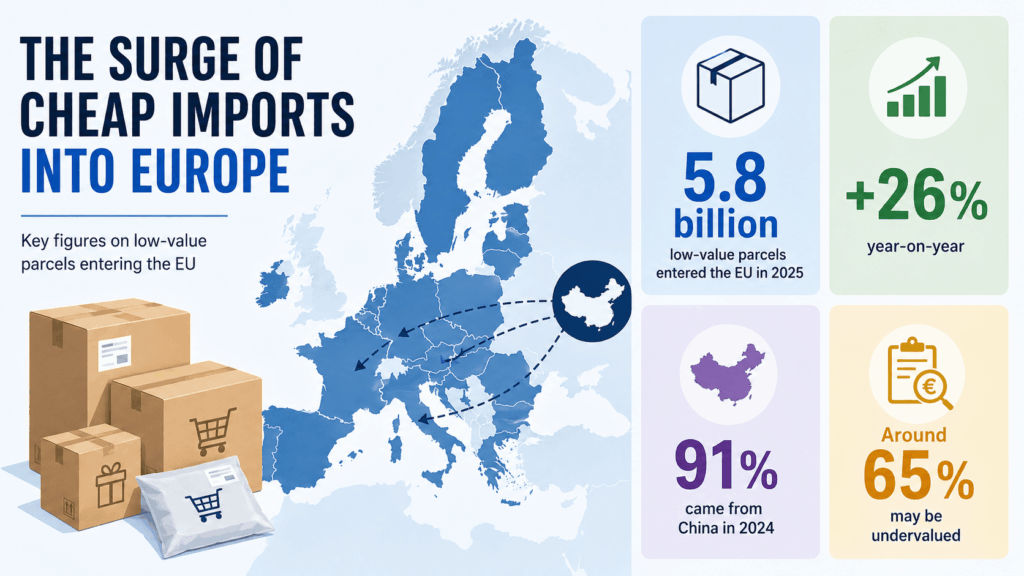
The move targets direct-to-consumer parcels coming into Europe through platforms such as Shein and Temu. Reuters reported in 2025 that low-value eCommerce parcels entering the EU reached 5.8 billion in 2025, up 26% on the previous year. The EU also believes that around 65% of those parcels may be undervalued.
The policy highlights a broader market shift. In recent years, Irish and EU-based businesses have had to compete against ultra-cheap imports that took advantage of the low-value exemption, and supply chains built around rock-bottom pricing. The new fee suggests that Brussels has decided this pricing imbalance is too big to ignore.
For Irish SMEs selling into the EU or competing with low-cost imports, this raises an important question. Could local and EU-based businesses now have more room to compete on service, trust, delivery and quality?
Jamie Nuttall has a grounded view of how Irish SMEs can grow in complex European markets. Jamie is the founding Director of Infinite North Advisory Limited, a consultancy focused on fractional business development leadership, sales systems architecture and international expansion strategy. After hearing him speak at a recent Skillnet Innovation Exchange webinar, we reached out for his perspective on what the new parcel fee could mean in practice:
“The removal of the €150 exemption isn’t just an operational shift, it’s a massive policy signal from the EU. From July 2026, introducing the interim €3 flat-rate duty marks the beginning of the end for ‘duty-free’ imports,” said Jamie.
“For Irish SMEs competing domestically and across EU markets, the significance isn’t in the duty itself, but in reducing price distortion. We are moving toward a level playing field where Irish businesses no longer have to compete against artificially low-cost imports entering the EU that bypass the fiscal responsibilities EU businesses face every day.”
Jamie nails it by pointing out that the main story here isn’t the €3 fee, but where this change could lead, and what it signals about the future direction of European ecommerce.
What has actually changed
In plain English, the EU is making very cheap imports less artificially cheap.
The parcel duty sits within a wider push to tighten the rules around low-value goods entering the EU. Reuters reported that 91% of low-value eCommerce shipments into the EU in 2024 came from China. EU institutions have tied the changes to unfair competition, consumer safety concerns and fraud linked to undervaluation. RTÉ also reported earlier Commission plans for a separate handling fee, which underlines how seriously Brussels is taking the issue.
At the scale now involved, this goes far beyond customs admin. Billions of parcels shape market behaviour. They affect pricing expectations, margins, category norms and how difficult it is for Irish businesses to hold their ground when buyers have been trained to expect ultra-cheap products delivered straight to their door.
Why this matters in Ireland
For Irish SMEs in eCommerce, fashion, gifting, homeware, beauty, accessories and similar sectors, the rise of ultra-cheap imports has completely changed the mindset of buyers.
Rock-bottom pricing has become normalised in many categories. Endless choice has become standard. Patience has fallen. That puts real pressure on businesses trying to compete on quality, service, local delivery, product knowledge, stronger returns policies or a more responsible model.
If there’s a bit of pushback on these ultra-cheap products, the competitive picture can start to shift, as Jamie adds: “The real opportunity here is for Ireland’s SMEs to reclaim their ‘home court’ advantage. As the gap narrows between cheap imports and local quality, Irish businesses should double down on service, sustainability, and brand trust.
“Before reacting, I’d advise SMEs to review their supply chain exposure and fulfilment models. If you’re relying on non-EU dropshipping, that model is becoming increasingly fragile. Moving toward EU-based fulfilment or leveraging the IOSS system isn’t just about compliance anymore: it’s about protecting your customer experience from surprise fees at the door.”
Jamie’s advice has real weight. A business that has already been winning on trust, speed, reliability or service could find those strengths easier to sell if the pure price gap narrows. A business relying on fragile fulfilment models could find the opposite.
The market is already reacting
Pressure to introduce this policy has been building across the market for some time. Critics argued that platforms such as Shein and Temu had an unfair advantage because low-value parcels entered duty-free, while comparable goods would normally face customs duties.
The Irish reaction has been more measured than celebratory. RTÉ reported that Fine Gael MEP Regina Doherty welcomed stronger controls around product safety but also raised questions about practical implementation and cost-of-living impact. The same piece quoted TU Dublin retail management lecturer Damian O’Reilly, who pointed to the customs workload involved and suggested the fee could also be understood as a way to cover those costs.
So the fee isn’t a guaranteed commercial win. The likely impact will vary by category, business model and supply chain exposure.
There is also evidence that the wider market has already been responding to the pressure created by ultra-cheap imports. In December 2025 Amazon cut seller fees across Europe amid the price war driven by Shein and Temu, which is a huge move considering its monolithic influence on the online marketplace.
The opportunity depends on research
Back to that webinar Jamie hosted recently, where he was emphatic that the single biggest reason for export businesses failing is lack of research. This applies to policy changes as well as hard launches.
Irish exporters shouldn’t treat this story as a simple bloody nose for brazen Chinese mega-sellers. A smarter response starts with research. Look at where the pressure has been strongest, where buyers care about more than price, and where competitors may now be vulnerable.
Frame the issue as a recalibration towards fairer competition and comparison. Now is a good time to look again at how your category works, how competitors are selling, and whether your offer is strong enough to win if buyers become a little less fixated on the very lowest price.
What Irish SMEs should do now
Recheck your category
Look at how ultra-cheap imports have affected your category. If they have pushed prices down and changed how customers judge value, this change could be more important than it first looks.
Review your supply chain exposure
Jamie’s point on non-EU dropshipping matters. Extra charges, delivery problems and unclear shipping can quickly damage trust. If something goes wrong, the customer blames the seller.
Revisit your value proposition
If this change gives you more room to compete, be clearer about what sets you apart. That could be better quality, stronger service, easier returns, local support, trusted fulfilment, more sustainable sourcing, or stronger product knowledge.
Check your digital journey
If buyers start looking beyond the cheapest option, your website needs to be ready. Product pages, delivery details, returns information, trust signals and checkout all need to do their job.
Watch competitors closely
Some competitors will move quickly. Others will do very little. Watch how businesses in your category respond on price, fulfilment and messaging, not just what the regulation says.
The opening is there. Will you grab the opportunity?
Read this change as a market signal that Europe recognises the imbalance over the flood of ultra-cheap imports. The door is now open to a slightly fairer environment for businesses competing from within the EU, including Irish SMEs. Success will still come down to execution, category fit and preparedness.
Cheap imports are not disappearing. Irish SMEs are not suddenly in the clear. What has changed is the chance to compete in a market that may begin to reward trust, service and stronger fundamentals a little more than in recent years.
Europe has changed the rules, and Irish SMEs should now ask how they can bend into shape to take advantage.
Turning insight into action
A shift like this is only useful if you can turn it into a smarter export plan. Export Spark is Matrix Internet’s step-by-step export growth programme for Irish businesses entering new markets, combining research, strategy, digital delivery and digital marketing in one focused push. If your business is rethinking how to compete in Europe, see how Export Spark works.
By Conor McCaffrey


