

BLOG
Core Web Vitals in 2026
10 min read
Matrix is proud to join PACE, now launched in Moldova. The Erasmus+ project strengthens youth organisations across the region with training, digital resources and collaboration to support displaced Ukrainian young people.
Why Performance Must Be Built In From Day One — Not Bolted On at the End
There is a persistent misconception in web development that performance is something you fix after launch. You build the website, you go live, and then — if someone complains it is slow — you start optimising. This approach made some sense in 2010. In 2026, it is a business liability.
Core Web Vitals are Google’s framework for measuring real-world user experience. Since 2021, they have been official ranking signals. Since 2024, the metrics themselves have been updated to better reflect how users actually experience the web. And since the December 2025 Core Update — the most significant algorithm change of last year — the bar has been raised again.
Sites with poor Core Web Vitals are now demonstrably losing ranking positions, traffic, and revenue. This is not a prediction. It is a documented pattern affecting tens of thousands of websites globally.
This article explains what Core Web Vitals are, why they need to be an architectural decision made before a single line of code is written, and what we do differently at our Dublin agency as a result.
What Are Core Web Vitals?
Core Web Vitals are a set of three performance metrics that Google uses to evaluate the real-world user experience of a webpage. They are measured using data collected from actual Chrome users — not simulated lab tests — which makes them a genuine reflection of how your visitors experience your site.
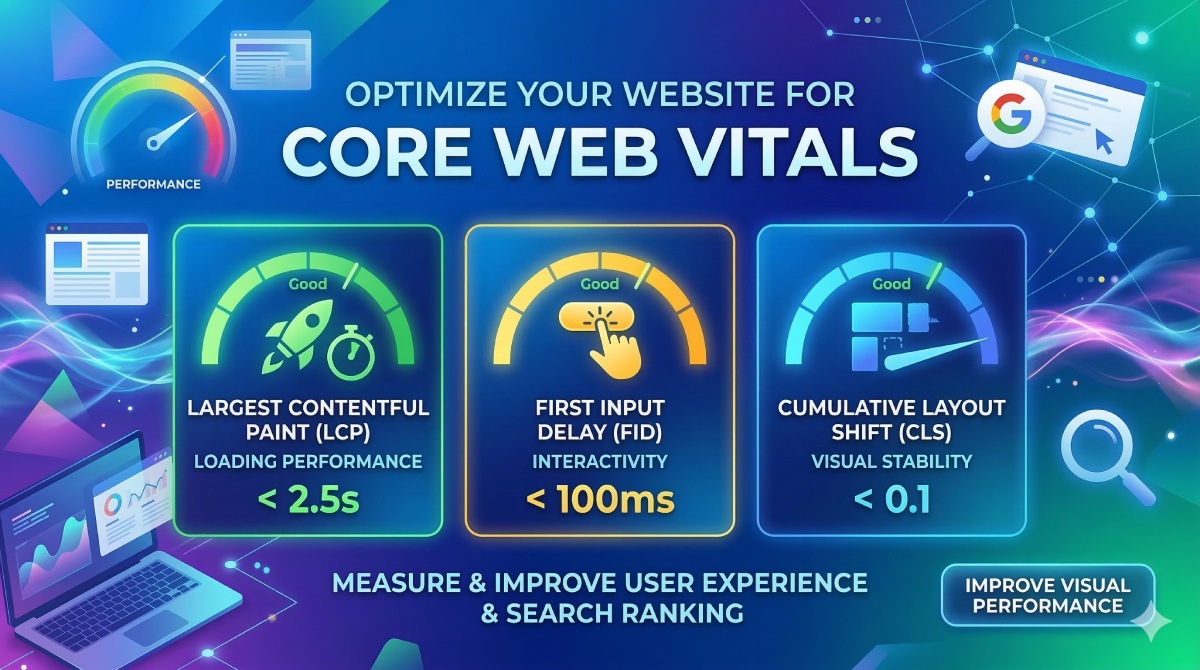
The three metrics, as of 2026, are:
| Metric | What It Measures | Good Score | Needs Improvement |
| LCP | Loading performance | Under 2.5 seconds | 2.5 – 4.0 seconds |
| INP | Interactivity | Under 200ms | 200ms – 500ms |
| CLS | Visual stability | Under 0.1 | 0.1 – 0.25 |
Largest Contentful Paint (LCP)
LCP measures loading performance — specifically, how long it takes for the largest visible element on the page to fully render. This is typically a hero image, a large block of text, or a video thumbnail. Google’s threshold for a ‘good’ score is under 2.5 seconds, but in practice, for competitive ranking positions, targeting under 1.5 seconds is increasingly necessary.
LCP is directly tied to your server response time. If your hosting infrastructure takes 400ms just to respond before sending a single byte, your LCP starts at a 400ms disadvantage before the browser has rendered anything.
Interaction to Next Paint (INP)
INP replaced First Input Delay (FID) in March 2024 and is a significantly more demanding metric. While FID only measured the delay on a user’s first interaction, INP tracks the latency of every interaction — every click, tap, and keyboard input — across the entire session, and uses the worst-case value. A good score is under 200 milliseconds.
INP failures are most commonly caused by heavy JavaScript execution blocking the main browser thread. This is directly a development architecture problem — one that cannot be retroactively patched without substantial code changes.
Cumulative Layout Shift (CLS)
CLS measures visual stability — how much page content unexpectedly moves around while loading. A score under 0.1 is considered good. CLS failures happen when images load without defined dimensions, fonts load and change text layout, or dynamic content is injected above existing content.
Like INP, CLS is a structural problem. It cannot be fixed with a plugin. It needs to be designed out from the start.
The December 2025 Core Update: The Stakes Just Got Higher
Google’s December 2025 Core Update was the third and most impactful algorithm change of 2025, completing its rollout in early January 2026. Analysis of the update across hundreds of affected websites revealed a clear pattern that should concern every business with an online presence.
Key finding — Sites with poor Core Web Vitals experienced 20–30% more severe traffic losses during the December update compared to faster competitors with equivalent content quality.
This is a significant escalation. In previous algorithm cycles, Core Web Vitals functioned primarily as a tiebreaker between pages of otherwise equal quality. The December 2025 update indicates they are now functioning closer to a quality threshold — pages below the performance bar are being competitively disadvantaged even when their content is strong.
The direction of travel is clear. Google has repeatedly indicated that technical performance standards will continue to rise as baseline user expectations increase. What constitutes ‘acceptable’ performance in 2026 will be insufficient by 2027.
The Business Case: Performance Is Revenue
The argument for Core Web Vitals optimisation is sometimes framed purely as an SEO concern. It is also a direct revenue concern. The data on this point is extensive and unambiguous.
7% reduction in conversions for every additional one-second delay in page load time.
53% of mobile users abandon a site that takes longer than 3 seconds to load.
2.5× higher conversion rates for sites loading in 1 second versus 5 seconds.
€2.6 billion lost annually by online businesses globally due to slow-loading sites.
32% increase in bounce rate when load time goes from 1 to 3 seconds.
These are not edge cases. They are consistent findings across multiple independent research programmes over several years. The relationship between performance and commercial outcome is one of the most reliably documented in digital marketing.
The real-world case studies make the point even more concretely. Vodafone achieved a 31% LCP improvement and saw an 8% increase in sales alongside an 11% improvement in cart-to-visit rate. Rakuten increased Core Web Vitals performance and saw a 53% uplift in revenue per visitor and a 33% improvement in conversion rate. Swappie improved Core Web Vitals and saw mobile revenue increase by 42%. Renault achieved a one-second LCP improvement and recorded a 13% rise in conversions.
For an Irish e-commerce business turning over €2 million annually, a 7% conversion rate improvement from performance optimisation represents €140,000 in additional revenue. This is not a marginal technical consideration. It is a strategic business decision.
Why Performance Cannot Be Retrofitted
This is the central argument of this article, and it is worth stating directly: Core Web Vitals performance cannot be reliably achieved by optimising an already-built website. It must be designed into the architecture from the beginning.
Here is why.
LCP Failures Are Infrastructure and Architecture Problems
The most common causes of poor LCP are slow server response time (TTFB), render-blocking JavaScript and CSS, and unoptimised images without proper priority loading. Each of these is an architectural decision.
Server response time is determined by your hosting infrastructure, whether you are using edge computing or centralised servers, and how your application handles server-side rendering. You cannot change this without changing your infrastructure.
Render-blocking resources are the result of how JavaScript and CSS are structured and loaded. In a poorly architected codebase, critical CSS may be loaded in external stylesheets that block rendering, and large JavaScript bundles may execute before the page can paint. Retrofitting this requires significant refactoring, not a simple configuration change.
Image optimisation is straightforward as a standalone task, but in a CMS-driven site it requires that the image pipeline — including upload handling, format conversion, and responsive serving — is built correctly from day one. Adding WebP conversion and responsive images to an existing site after launch involves touching every image in the content library.
INP Failures Are JavaScript Architecture Problems
Poor INP scores are caused by long tasks blocking the main browser thread. The main thread in a browser handles rendering, JavaScript execution, and user input processing. When a long JavaScript task is running, user interactions queue up and wait — producing the sluggish, unresponsive experience that INP captures.
The solution to INP problems is to break long tasks into smaller chunks, defer non-critical JavaScript, and move heavy computation off the main thread using Web Workers. In a codebase that was not designed with this in mind, implementing these changes is a substantial refactoring exercise.
Modern frameworks and build tools — when configured correctly from the start — handle much of this automatically through code splitting, lazy loading, and tree shaking. Adding these capabilities to a project that was not built with them requires architectural changes that touch the entire codebase.
CLS Failures Are Design and Implementation Problems
A layout shift happens when the browser does not know how much space to reserve for elements before they load. The fix is simple: always define explicit dimensions for images, videos, and iframes. Always reserve space for dynamically injected content. Always use font-display strategies that prevent text layout recalculation when custom fonts load.
These are not difficult to implement — but they need to be implemented consistently across every element of the site. Retrofitting them means auditing and correcting every image, every dynamic component, and every font loading implementation across the entire codebase.
The core problem — Each of these fixes is simple in isolation. Applied to an existing, already-live website with hundreds of pages, dynamic content, and third-party integrations, they become a significant project. The same effort applied at the design and development stage takes a fraction of the time.
What Performance-First Development Actually Looks Like
At our agency, we have restructured our development process so that Core Web Vitals targets are defined before design begins and validated at every stage of the build — not measured for the first time at launch.
Here is what that looks like in practice:
Performance Budgets Before Design
We establish performance budgets at the project scoping stage. A performance budget defines the maximum allowed values for metrics like total page weight, JavaScript bundle size, number of render-blocking resources, and TTFB — before a single design decision has been made. If a proposed feature would breach the budget, we evaluate whether it is worth the performance cost before implementing it, not after.
This changes conversations that would otherwise happen after launch. Rather than ‘this animation makes the page beautiful’ versus ‘this animation breaks our INP score,’ the discussion happens upfront where the cost is a design consideration, not a technical emergency.
Infrastructure Selection Based on Performance Requirements
For Irish businesses, hosting choice has a direct impact on TTFB and therefore LCP. We evaluate infrastructure before development begins. For most client projects in 2026, this means deploying on edge computing infrastructure — specifically Cloudflare Workers — which moves code execution to servers geographically close to the user. The TTFB improvement from a centralised server (typically 200–400ms for Irish users on non-EU-hosted infrastructure) to an edge deployment (typically under 30ms) directly translates to better LCP scores before any application-level optimisation has been done.
Component-Level Performance Contracts
We define performance requirements at the component level during development. Every image component is built to output WebP and AVIF formats with explicit dimensions and responsive srcset attributes by default. Every third-party script integration is evaluated for its main thread impact before it is added to the project. Every font is configured with font-display: swap to prevent layout shift during load.
These are not optimisations applied after the fact. They are the default. The developer writing a new component produces performant output because the component library and tooling enforce it.
Continuous Performance Monitoring in CI/CD
We run automated Lighthouse and Web Vitals tests as part of our continuous integration pipeline. Every code change that goes through our review process is tested against performance baselines. If a pull request degrades LCP by more than 200ms or introduces a CLS score above 0.05, it is flagged before it reaches production.
This means performance regressions are caught at the point where they are cheapest to fix — before they are deployed — rather than after a user complains or a Google ranking drop is noticed.
Real User Monitoring After Launch
Lab tests and simulated performance scores are useful proxies, but Core Web Vitals rankings are determined by real user data collected from Chrome. We set up real user monitoring (RUM) for client sites using Google Search Console’s Core Web Vitals report alongside additional tooling to capture field data. This allows us to observe actual user experience across different devices, connection speeds, and geographies — and to respond to performance issues before they accumulate enough negative signal to affect rankings.
Core Web Vitals and AI Search: An Emerging Consideration
A less-discussed dimension of Core Web Vitals in 2026 is their relationship to AI-powered search. Google’s AI Overviews, ChatGPT search, Perplexity, and similar tools are generating answers from indexed web content — and the signals they use to evaluate which sources to cite are evolving.
There is growing evidence that page experience quality — which includes Core Web Vitals — functions as a credibility signal for AI citation. A page that delivers a poor user experience may be deprioritised as a source in AI-generated summaries, even if its content is high quality. As AI-driven search continues to grow its share of discovery traffic, this consideration becomes increasingly commercially significant.
For Irish businesses investing in content marketing and SEO, the implication is straightforward: technical performance is now relevant to visibility in both traditional search results and AI-generated search experiences.
What to Do If Your Current Site Is Underperforming
If your existing website has poor Core Web Vitals scores, there is a structured approach to improvement. It is worth being realistic: depending on the current state of the codebase and infrastructure, meaningful improvement may require more than configuration changes.
The first step is accurate diagnosis. Google Search Console provides field data on Core Web Vitals performance for your actual users, segmented by page type and device. PageSpeed Insights gives you both field data (from the Chrome User Experience Report) and lab data with specific diagnostic recommendations. These tools will tell you where your largest problems are.
The most common high-impact improvements are:
- Migrating to edge or CDN-based hosting to reduce TTFB — this is often the single highest-impact change available.
- Implementing image lazy loading and explicit dimensions across all images to improve LCP and CLS simultaneously.
- Auditing and deferring non-critical JavaScript to address INP and LCP blocking.
- Enabling server-side or static rendering for key pages to reduce time-to-render.
- Removing or replacing third-party scripts that have high main thread impact — analytics, chat widgets, and ad platforms are common offenders.
For sites in need of comprehensive improvement, the most efficient path is often a rebuild with performance-first architecture rather than iterative patching of structural problems. The decision depends on the scope of the issues and the commercial importance of organic search to the business.
The Argument for Getting It Right the First Time
Building a website is an investment. In Ireland, a professionally built business website typically represents a significant commitment of budget, time, and organisational energy. That investment should not have to be revisited within 12 months because Google has penalised the site for poor performance.
The incremental cost of building performance-first — establishing budgets, selecting the right infrastructure, instrumenting the CI pipeline, building performant components — is modest compared to the cost of retrofitting a site that was built without these considerations. And the return, in the form of better organic rankings, higher conversion rates, and lower bounce rates, begins immediately at launch rather than after a remediation project.
In 2026, Core Web Vitals are not an advanced optimisation for high-budget projects. They are the baseline expectation for any professionally built website. Agencies and developers who treat them as an afterthought are building sites that will underperform from the day they go live.
Our standard — Every website we build at our Dublin agency is tested against Core Web Vitals targets before launch. Performance budgets are agreed at scoping. Infrastructure is selected for speed. Monitoring is configured from day one. We do not treat performance as a post-launch optimisation.
Is your website performing?
We offer a no-obligation Core Web Vitals audit for Irish businesses. We will analyse your current LCP, INP, and CLS scores using real user data from Google Search Console, identify your highest-impact improvement opportunities, and give you a clear picture of how your site compares to competitors for your target keywords.
If you are planning a new website build or a redesign, we would welcome the opportunity to show you what performance-first development looks like in practice.
By Matrix Internet