
BLOG
Cookie Consent Mode and Google Partners
Understanding Google’s Consent Mode Google’s Consent Mode is a framework that allows websites to adjust how Google tags behave based on user consent choices. Introduced to help businesses comply with privacy regulations like GDPR and ePrivacy Directive, Consent Mode bridges the gap between respecting user privacy and maintaining meaningful analytics data. How Consent Mode Works […]
Understanding Google’s Consent Mode
Google’s Consent Mode is a framework that allows websites to adjust how Google tags behave based on user consent choices. Introduced to help businesses comply with privacy regulations like GDPR and ePrivacy Directive, Consent Mode bridges the gap between respecting user privacy and maintaining meaningful analytics data.
How Consent Mode Works
Consent Mode operates by communicating the user consent status to Google tags through four key parameters:
- analytics_storage: Controls whether analytics cookies can be set
- ad_storage: Manages advertising cookies and remarketing capabilities
- ad_user_data: Governs whether user data can be sent to Google for advertising purposes
- ad_personalization: Determines if data can be used for personalised advertising
When users decline cookies, Google tags adapt by switching to a cookieless measurement approach, using techniques like modelling and conversion pinging to provide aggregated, privacy-safe insights.
The Importance of GDPR Compliance
The General Data Protection Regulation requires explicit user consent before storing non-essential cookies. Non-compliance can result in substantial fines of up to €20 million or 4% of global annual revenue, whichever is higher. A proper Consent Management Platform is essential for meeting these requirements while maintaining website functionality.
Leading Google Partners for Consent Mode Implementation
1. OneTrust
OneTrust is one of the most comprehensive privacy management platforms, widely trusted by enterprise organisations worldwide.
Key Features:
-
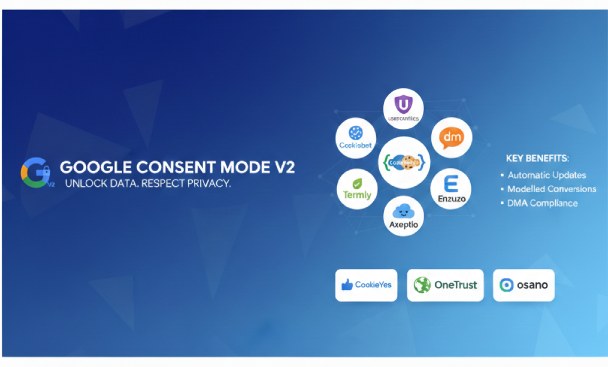
- Full Google Consent Mode v2 integration
- Automated cookie scanning and classification
- Multi-language and multi-region support
- Granular consent controls
- Real-time consent analytics dashboard
- Integration with major marketing and analytics platforms
Best For: Large enterprises requiring sophisticated privacy management across multiple regions and brands.
2. Cookiebot by Usercentrics
Cookiebot offers an intuitive, developer-friendly approach to consent management with strong Google integration.
Key Features:
-
- Automatic detection and control of all cookies and trackers
- Pre-built Google Consent Mode integration
- Customizable consent banner design
- Consent statistics and reporting
- Deep-scan technology for third-party cookies
- IAB TCF 2.2 compliance
Best For: Mid-sized businesses and agencies seeking a balance between functionality and ease of implementation.
3. CookieScript
Overview: CookieScript is a flexible, Google‑certified CMP that helps websites stay compliant with privacy regulations like GDPR and CCPA while supporting Consent Mode v2.
Key Features:
-
- Google Consent Mode v2 support — full integration, easily enabled in settings.
- Google‑certified CMP with IAB TCF v2.2 integration — suitable for publishers using Google ad products.
- Automated cookie scanning & blocking — detects, categorises, and manages cookies across domains.
- Customizable consent banners — design and behaviour tailored to your website’s branding.
- Multi‑jurisdiction & multilingual support — banners and compliance can adapt by region and translate into 40+ languages.
- Consent recording & audit logs — store user consent information for audits and compliance proofs.
- Script management — block first‑ and third‑party cookies and scripts until consent is given.
- Privacy policy generator — create basic privacy/cookie policy content based on detected cookies.
Best For: Websites and agencies looking for a cost‑effective, Google‑certified CMP with strong compliance features and customizable consent experiences.
4. Termly
Termly provides an accessible solution for small to medium-sized businesses looking for straightforward compliance.
Key Features:
-
- Simple Google Consent Mode setup
- Automated cookie scanning
- Consent banner customisation
- Privacy policy generator
- Affordable pricing tiers
- Easy integration with Google Tag Manager
Best For: Small businesses and startups needing cost-effective compliance solutions.
5. Osano
Osano combines consent management with broader data privacy compliance tools.
Key Features:
-
- Google Consent Mode v2 support
- Consent collection and preference management
- Vendor risk assessment
- Data subject request automation
- Privacy policy monitoring
- Cookie auto-blocking before consent
Best For: Companies seeking an all-in-one privacy compliance platform beyond just cookie consent.
6. Didomi
Didomi offers a sophisticated consent and preference management platform designed for complex organisational needs.
Key Features:
-
- Advanced Google Consent Mode implementation
- Consent rate optimisation tools
- Progressive consent collection
- Cross-device consent synchronization
- Preference center customization
- A/B testing for consent experiences
Best For: Data-driven organisations focused on optimising both compliance and user experience.
Key Considerations When Choosing a Solution
Technical Integration
Ensure the platform integrates smoothly with your existing tech stack, particularly Google Tag Manager, Google Analytics 4, and Google Ads. Look for solutions that offer clear documentation and support.
Customization Capabilities
Your consent banner should align with your brand identity. Evaluate the level of design customisation available, including colours, fonts, positioning, and messaging.
Cookie Scanning and Classification
Automatic cookie discovery is essential as modern websites often load third-party scripts that set cookies dynamically. Choose a platform that can continuously scan and classify cookies.
Performance Impact
Cookie consent scripts load on every page view. Select solutions that prioritise performance optimisation to avoid negatively impacting page load times and user experience.
Consent Rate Optimisation
Some platforms offer features specifically designed to maximise consent rates through strategic banner design, progressive consent, and A/B testing capabilities.
Reporting and Analytics
Understanding consent patterns helps refine your approach. Look for platforms that provide detailed analytics on consent rates, geographical variations, and user preferences.
Budget and Scalability
Pricing models vary significantly, from free solutions to enterprise platforms costing thousands annually. Consider your current needs and future growth when evaluating options.
Implementation Best Practices
1. Configure Consent Mode Before Deploying Tags
Set up Consent Mode in Google Tag Manager before your other tracking tags fire. This ensures no data is collected without proper consent signals.
2. Use Basic vs. Advanced Implementation
-
- Basic Mode: Tags don’t fire until consent is granted
- Advanced Mode: Tags fire with limited functionality, using modelling for declined consent
Advanced mode typically provides better data quality while maintaining privacy compliance.
3. Test Thoroughly Across Scenarios
Test your implementation with consent granted, consent denied, and partial consent scenarios. Verify that tags behave correctly in each situation.
4. Implement Consent Mode v2
Google now requires Consent Mode v2, which includes the additional ad_user_data and ad_personalization parameters for EEA and UK users accessing Google advertising features.
5. Provide Clear, Transparent Information
Your consent banner should clearly explain what cookies do, why they’re used, and give users genuine choice. Avoid dark patterns that manipulate user decisions.
6. Maintain Consent Records
Keep detailed logs of consent choices to demonstrate compliance during audits. Most partner solutions provide this functionality automatically.
7. Regularly Update Cookie Declarations
As your website evolves, new cookies may be added. Regularly scan and update your cookie declaration to maintain accuracy and compliance.
The Future of Consent Management
Privacy regulations continue to evolve globally, with new laws emerging in various jurisdictions. Google Consent Mode represents an evolving standard that will likely adapt to meet new regulatory requirements.
Key trends include:
- Increased focus on user preference centres beyond simple accept/decline
- Cross-device and cross-platform consent synchronization
- Integration of consent with broader privacy management
- Greater emphasis on consent rate optimisation
- Expansion of privacy-preserving measurement techniques
Conclusion
Implementing Google Consent Mode through a certified partner solution is no longer optional for businesses operating in regulated markets. The right platform helps you balance regulatory compliance, user privacy, and business intelligence needs.
Whether you choose a comprehensive enterprise solution like OneTrust, a developer-friendly option like Cookiebot, or another alternative, the key is selecting a partner that aligns with your technical capabilities, budget, and compliance requirements. By implementing consent management properly, you protect both your users’ privacy and your organisation’s reputation while maintaining the data insights needed to grow your business effectively.
Remember that compliance is an ongoing process, not a one-time implementation. Choose a partner that provides continuous updates, reliable support, and evolving features to keep pace with the changing privacy landscape.
If you are looking for a professional partner to handle your Consent banner setup and seamless integration with your existing systems, Matrix Internet Webdesign Agency in Dublin, Ireland, can help. Our team specialises in implementing GDPR- and ePrivacy-compliant solutions, ensuring that your website respects user privacy while maintaining full functionality and accurate analytics.
By Matrix Internet